

No match found Try a plainer description, or one word: roach flour beetles hole in the field lice wasp at the door droppings.
Salt Lake ValleyWasatch Front Edition · 2026
A Board Certified Entomologist’s Field Guide for Schools

The One-Hour
Entomology Degree

School Edition

Twenty years in the field, a master’s, and a board certification — minus the twenty years.

A custodian’s, kitchen manager’s, and facilities director’s guide to what matters, what doesn’t, and what to actually do about it.

Trent Frazer, Board Certified Entomologist
Your local entomologist
Trent Frazer, BCE
Board Certified Entomologist · M.S. Entomology · Falcon Pest Control

A Board Certified Entomologist with a master’s in the field and two decades building and running pest-control quality programs at scale. The credential is the highest in the field — and now it’s local. When a bug, a bird, or a burrow needs a real answer, Trent is the one to call.

Board Certified Entomologist seal: Trenton Frazer, MS, BCE, #B3413
Why this existsThis guide is written to satisfy the staff education requirement in Utah Administrative Code R392-200-18. Keep it where your people work.
How to use this guide

Flip to your problem. Get the answer.

This isn’t a textbook — it’s a desk reference for a Utah school building. Every pest gets the same six lines so you always know where to look: what it is, whether it matters, how it got here, whether it’ll get worse, whether you can legally handle it, and when it crosses the line into a real problem. Start with the Master Triage, then use the index to jump straight to whatever’s in front of you.

Leave it
A nuisance — ugly or annoying, no real harm. Tolerate it or do the simple fix.
Watch it
Matters in the wrong spot or if it grows. Worth handling, not an emergency.
Act on it
A genuine hazard — sting risk, disease, contamination, or real damage. Handle promptly.
DIY
Custodial or facilities staff can legally handle this. Mechanical work, no license.
Licensed pro
Crosses into licensed-applicator work. Make the call.
Protected
Illegal to kill under Utah law. Exclusion or DWR only.
Report it
Goes in the log whether or not anyone treats it.
The Master Triage

Five questions for anything you find

Before you do anything — or tell a teacher anything — run these in order. Most of it answers itself by question two.

What is it, actually?Not “a bug.” A German cockroach and an Oriental cockroach are different problems with different fixes. Half of what gets treated in schools is misidentified, and the wrong treatment usually makes it worse. If you’re not sure, photograph it and send it.
Where is it?The same insect means different things in different rooms. A fly in a hallway is nothing. Three flies in a kitchen is a source problem. A mouse dropping in a storage closet is a trap. A mouse dropping in a serving line is a same-day response.
Is this a condition or a pest?Almost every recurring pest problem in a school is a condition — a propped door, a failed drain trap, food in a desk, a gap under a threshold, standing water. Treating the pest without fixing the condition means you’ll treat it again.
Can you legally handle it?Mechanical work, exclusion, sanitation, and trapping need no license. Applying any pesticide does — including a can from home. And some things are illegal to kill at all.
Does it get recorded?Yes. All of it. Even “found nothing.” The state can ask to see your monitoring records, and a log that only shows problems can’t show a trend.
? Before you touch anything

Who Owns This Call?

Because in a school, more than one person does.

The first question isn’t “what is it” — it’s “is this mine, and who do I tell?”

The chain, in order
YouThe person who found it
Identify it if you can, write it down, and correct what’s in your control — sanitation, clutter, a propped door, a spill, standing water. Most pest problems in schools are conditions, and most conditions are yours to fix. This is the largest single lever in the whole program and it costs nothing.
Your IPM Site ManagerUsually the head custodian
Checks monitoring devices on schedule, confirms identification, decides whether a threshold has been crossed, keeps the building’s IPM binder.
The IPM CoordinatorDistrict or network level
Approves every pesticide before it’s used anywhere on school property, handles anything above a Site Manager’s authority, and keeps the records the health department can ask to see.
A licensed applicatorStaff or contractor
The only person who may apply a pesticide on school property. Not a teacher, not a coach, not a parent volunteer, not a custodian with a can from the hardware store.
The Entomologist of RecordFalcon Pest Control
Identification you can’t make. A recurring problem nobody can source. A complaint that needs documentation. Send a photo — you’ll get an answer the same day.
DWR or a permitted operatorProtected wildlife
Bats, native birds, rattlesnakes. Protected under state and federal law, and the answer is never a kill.
The dividing questionIs this something I can fix, something I report, or something that’s illegal for anyone here to touch?
Quick-reference index

“I’ve got a…”

What you’re seeingGo to
Small striped roach in the kitchen§1 · German cockroach
Big dark slow roach near a drain§1 · Oriental cockroach
Beetles or webbing in flour, grain, or dry goods§1 · Stored product pests
Little fuzzy flies at a floor drain§1 · Drain flies
Tiny flies around fruit or the mop sink§1 · Fruit flies
Ants trailing across a counter§1 · Ants in the kitchen
A parent called about head lice§2 · Head lice
A teacher says “bed bugs”§2 · Bed bugs
Silvery fast bug in the library or a book room§2 · Silverfish & booklice
Crickets everywhere in September§2 · Crickets
Swarms of bugs on a sunny wall§2 · Boxelder & elm seed bugs
Droppings in a classroom or closet§3 Rodents
A hole or mound in the field§4 Burrows & holes
Wasps at a door, playground, or dumpster§5 Stinging & flying
A scary spider§6 Spiders
Mud tubes on a foundation§7 · Subterranean termites
Pigeons or starlings fouling a walkway§8 Birds
Bats in an attic, a snake, a raccoon§9 Bats & wildlife
Beetles in a science specimen collection§10 Specialty spaces
“Can I just spray it myself?”What school staff may and may not do
“Do I have to tell parents?”Notification
“How many is too many?”When it becomes a program
“What’s coming next month?”The school-year calendar
1 Cafeteria, Kitchen & Food Service

The Highest-Consequence Area in the Building

A health inspector will look here.

Nowhere else in a school carries both a pest problem and a licensing consequence. Everything in this section is a kitchen matter, and everything in it goes in the log.

The two roaches you will actually see
Photo to comeGerman cockroach — adult, showing the two dark stripes behind the head
Photo to comeOriental cockroach — adult, for contrast: larger, near-black, glossy
Size and color separate them, and the fix follows the species. Small and striped is a German cockroach, an indoor breeder and the one that becomes an emergency. Large, near-black, and slow is an Oriental cockroach, which is telling you about moisture.
German CockroachBlattella germanica — the one that builds real infestations
Act on itLicensed proReport it
What it is
Small, about half an inch, light brown, with two dark stripes running back from behind the head. Lives indoors and stays tight to warmth, food, and moisture — under and behind dish machines, inside motor housings, along the underside of prep tables, inside hollow table legs, in the seams of cardboard.
Does it matter?
More than anything else in this guide. They reproduce explosively, a single female can found a population, they contaminate food surfaces, and their shed skins and droppings are a documented asthma trigger in children. This is the one that becomes a closure conversation.
How it got here
Almost always delivered. In cardboard, in produce boxes, on a used appliance, in a returning food cart, in a staff member’s belongings. Cardboard is the vector. Break down and remove delivery boxes the day they arrive — never store them.
Resolve or escalate?
Escalates fast and never self-resolves. Populations double in weeks.
DIY or pro?
Professional, always. Over-the-counter sprays scatter German roaches into wall voids and make the problem harder and more expensive to solve. Gel bait placed in harborage plus sanitation is the method.
Protected?
No.
Threshold
One confirmed German cockroach in a food handling area is the trigger. Not five. Not a pattern. One.
Oriental CockroachBlatta orientalis — the “water bug”
Watch itLicensed proReport it
What it is
Larger, close to an inch, very dark and glossy, almost black, and slow moving. The roach people call a water bug.
Does it matter?
A sanitation and contamination concern, but they don’t explode indoors the way German roaches do. What they really signal is a moisture problem worth finding.
How it got here
Moisture. Floor drains, mop sinks, sump areas, damp basements, mulch and wet ground against the foundation. They come up through drains. Older Salt Lake Valley buildings on aging sewer lines see this most, and it is by far the most common roach in Utah schools.
Resolve or escalate?
Seasonal pulses, worst in warm months and after rain. Won’t resolve while the moisture source is there.
DIY or pro?
The lever is the moisture, not the insect. Keep drains flowing and trapped, run water in floor drains that go dry over breaks, fix the leak, pull mulch back from the foundation. A pro handles the perimeter and drain treatment.
Protected?
No.
Threshold
Repeated appearances from a drain or basement means a moisture problem to fix, not just roaches to kill.
American CockroachPeriplaneta americana — the big one, and the least common here
Watch itLicensed proReport it
What it is
Reddish brown, up to an inch and a half, and capable of short flights. Uncommon in Utah relative to the other two.
How it got here
Warm, humid, large-volume spaces — sewers, steam tunnels, boiler and mechanical rooms, large commercial kitchens. Usually entering from drains or below rather than breeding in the room you found it in.
DIY or pro?
Professional, tied to the entry route. Find the drain, sewer line, or mechanical penetration and seal and treat there.
Protected?
No.
Threshold
Several in a mechanical room or a large kitchen means tracing the entry point.
Stored Product Pestsconfused flour beetle · sawtooth grain beetle · Indianmeal moth · cigarette beetle
Act on itLicensed proReport it
What it is
Small beetles or small moths in dry storage, or webbing and clumping in flour, grain, cornmeal, rice, dry pasta, birdseed, or classroom pet food. Indianmeal moth larvae leave silk webbing across the surface of product and in the folds of packaging — that webbing is the clearest single sign.
Here’s the part nobody knows
They arrive already in the product. Infestation begins at the mill, in the warehouse, or in transit — not in your building. Nothing you did caused it, and no amount of cleaning the storeroom prevents it. Inspection at receiving is the only real control.
Does it matter?
Yes. Contaminated food, wasted inventory, and a finding on a health inspection. In a district with a central warehouse this compounds — one infested pallet seeds every school it’s distributed to.
Resolve or escalate?
Escalates. They breed in the product itself, so an unopened bag gets worse in storage.
DIY or pro?
Both, and the DIY half matters more. Inspect incoming deliveries. Rotate stock first in, first out. Store dry goods in sealed hard containers, not paper sacks. Discard anything with webbing or live insects rather than trying to salvage it. A professional sets pheromone monitors to catch it early and traces the source back.
Protected?
No.
Threshold
Any live adult, larva, or webbing in stored product. A single pheromone trap capture triggers an inspection of the stock, not a treatment of the room.
What it looks like in the product
Photo to comeIndianmeal moth webbing across the surface of product and in packaging folds
Photo to comeConfused flour beetle and sawtooth grain beetle, with scale
Webbing is the tell. Silk across the surface of flour or grain, or in the folds of a bag, is Indianmeal moth. Small beetles moving in the product itself are flour or grain beetles. Either one means inspect the stock, not treat the room.
Drain FliesPsychodidae — the little fuzzy ones at the sink
Watch itDIYReport it
What it is
Tiny, fuzzy, moth-like, and weak fliers. They appear near floor drains, mop sinks, and under dish machines, and they breed in the organic film lining the inside of the drain pipe.
Does it matter?
Not a disease risk. But they’re the clearest sign in the building that a drain has a biofilm problem, and they’re visible to inspectors and to parents.
DIY or pro?
DIY — and spraying does nothing. The adults you see are the tail end of the problem. The fix is mechanical: scrub the inside of the drain with a stiff brush, then use a bacterial or enzyme drain product. Pouring bleach down the drain does not work — it runs straight through without touching the film that’s actually feeding them.
Protected?
No.
Threshold
Any recurring population means the drain needs cleaning, not treatment.
Photo to comeDrain fly resting on the rim of a kitchen floor drain
Fuzzy, moth-like, and always near a drain. The adults on the wall are the end of the problem; the biofilm inside the pipe is the beginning of it.
Fruit FliesDrosophila — the top-three kitchen complaint
Watch itDIYReport it
What it is
Tiny, tan, red-eyed, hovering around anything fermenting. Fast generations — egg to adult in about a week in a warm kitchen.
Where they’re breeding
Not where you see them. Look for the fermenting material: under and behind coolers, in the drip tray, in a mop bucket, in the gap beneath a dishwasher, in a recycling bin with soda residue, in a floor drain, in a bag of onions or potatoes going soft in storage.
DIY or pro?
DIY entirely. Find the source and remove it and the population collapses in days. Spraying adults accomplishes nothing because the breeding material is still there. A cup of apple cider vinegar with a drop of dish soap is a useful monitor — it tells you which end of the room they’re coming from.
Protected?
No.
Threshold
It’s a sanitation call. Persistent flies with no findable source usually means something is behind or under an appliance that hasn’t been moved.
Phorid FliesPhoridae — the one that means something bigger
Act on itLicensed proReport it
What it is
Small, humpbacked, and they run erratically across a surface rather than fly — that scurrying is the identifying behavior. Easy to mistake for a fruit fly.
Why this one matters more
Phorid flies breed in decomposing organic matter, including material in a broken sewer line or under a cracked slab. A persistent phorid population in a kitchen or restroom is a well-known indicator of a drain line failure beneath the floor.
DIY or pro?
Professional, and possibly a plumber. If sanitation and drain cleaning don’t resolve it, the next step is a camera in the line — not more pesticide.
Protected?
No.
Threshold
A recurring population that survives thorough drain cleaning is a building problem, not a pest problem.
Look-alike: fruit fly vs phorid fly
Photo to comeFruit fly — tan body, red eyes, hovers
Photo to comePhorid fly — humpbacked profile, runs across the surface
Watch what it does, not just what it looks like. A hovering red-eyed fly at fermenting material is a fruit fly and a sanitation job. A humpbacked fly that scurries across the counter is a phorid, and a persistent one points under the slab.
House Flies & Filth FliesMusca domestica and kin
Watch itDIYReport it
What it is
The ordinary fly, indoors, in numbers.
Where it comes from
Dumpster proximity, propped doors, a missing door sweep, a failed screen, or something decomposing. Persistent flies in one room with no obvious source usually means something died in a wall void.
DIY or pro?
Sanitation and exclusion. Move the dumpster or clean the pad, fix door sweeps and screens, find the source. Sticky ribbons and light traps catch adults but don’t touch breeding.
Protected?
No.
Threshold
One or two is nothing. Three or more in a food area is a source problem.
Ants in the Kitchenusually odorous house ants
Leave itDIY-ableReport it
What it is
Trailing ants on counters, along baseboards, at the mop sink. Usually odorous house ants — they smell faintly of coconut when crushed.
Does it matter?
A contamination nuisance. Not a health emergency, and not structural.
DIY or pro?
Do not spray the trail. Spraying splinters the colony into satellite nests and turns one trail into four. Wipe the trail with soapy water to destroy the scent line, remove the food and moisture, and set a consumer bait so they carry it home to the colony.
Protected?
No.
Threshold
Persistent trails after sanitation correction — then it goes to a pro.
The kitchen bottom lineOne German roach is an emergency. An Oriental roach is a moisture problem. Beetles in the flour came in with the flour. Little flies at a drain mean the drain, not the fly.
2 Classrooms & Common Areas

Where the Pests Are Minor and the Phone Calls Aren’t

Two of these you must never treat the building for. Read those first.

⚠ Head Lice — the thing you never treat the building for
Leave itNever a pesticide application
Do not treat the roomHead lice cannot survive away from a human host long enough for treating a room to have any value. They die within a day or two off a person, and they cannot live in carpet, on upholstery, or on a bus seat.

Never fog, spray, or treat a classroom, a bus, a gym mat, or a carpet for head lice. It exposes children to pesticide for zero benefit, and it is the single most common unnecessary pesticide application in American schools.

Vacuum if you want to. Launder what you want to. That is the entire building response. Everything else is a school nurse and family matter, not a facilities matter.

If a pest control vendor ever proposes treating a school for head lice, that vendor should not be servicing schools.
⚠ Bed Bugs — introduction is not infestationCimex lectularius
Act on itLicensed proConfirm before anything
Confirm before anythingAn introduction is one or a few insects that rode in on a person’s belongings. An infestation is a reproducing population with multiple life stages living in the building.

Schools get introductions. Schools almost never get infestations — because there’s no host sleeping in the building for a population to feed on.

Treating an introduction as an infestation causes unnecessary pesticide exposure, alarms an entire community, costs real money, and doesn’t help anything.
What it is
Flat, apple-seed sized, reddish brown. In a school they arrive on backpacks, coats, and belongings from an infested home.
What to actually do
Confirm the identification first — send a photo, and don’t act on a guess. Reduce clutter, which is the single most effective preventive measure a school has. Handle the student’s situation confidentially and do not exclude them from school. Inspect the specific area thoroughly before concluding anything is established.
Threshold
A confirmed specimen triggers inspection and identification. Multiple life stages found in the building — eggs, nymphs, and adults together — is the only thing that triggers treatment.
Photo to comeBed bug — adult, with a scale reference
Flat, apple-seed sized, reddish brown. Confirm the identification from a photo before anyone concludes anything, because almost everything reported as a bed bug in a school is something else.
Mice in Classroomssee §3 for the full rodent entries
Watch itDIY-ableReport it
What’s driving it
The school-specific driver is food in desks and lockers. A classroom mouse problem is almost always a food storage problem — snacks in desks, food left in backpacks overnight, classroom pet food in paper bags, and the teacher’s reward drawer.
The real fix
A conversation with teachers, not a trap line. You can trap the mice you have; you can’t trap your way out of forty desks with granola bars in them.
Setting traps around students
Traps in classrooms go where students cannot reach, and use snap traps rather than glue boards anywhere children are present.
Threshold
Any evidence in an occupied classroom gets logged and trapped, and the food-storage conversation happens the same week. Full rodent entries in §3.
Silverfish & BookliceLepisma saccharina · Psocoptera
Leave itDIYSpecialty space
What it is
Silverfish are teardrop-shaped, silver-grey, fast, with three tail filaments. Booklice are tiny, pale, and slow — often mistaken for dust that moves.
Where they are
Libraries, book rooms, paper storage, and anywhere humidity sits — basements, closets on exterior walls, rooms the HVAC doesn’t reach evenly.
Does it matter?
They feed on the sizing, paste, and glue in book bindings and on paper. The damage is slow and it isn’t reversible.
DIY or pro?
This is a humidity problem, not an insect problem. Below roughly 50% relative humidity they don’t thrive. Fix the moisture, improve air movement, and the population collapses on its own. Treatment without addressing humidity doesn’t hold.
Threshold
Any in a collection or archive area means addressing the humidity.
Photo to comeSilverfish — teardrop body, three tail filaments
Teardrop, silver-grey, three tails, and fast. Where you find them is the diagnosis: they are telling you a room is holding humidity.
Cricketsfield and house crickets — the September phone-call generator
Leave itDIYReport it
What it is
Field crickets and house crickets, indoors, usually in ones and twos — loud out of all proportion to their significance.
Why September
They move toward warmth as nights cool, and they come in under doors and through the same gaps everything else uses. They generate more fall complaints in Utah schools than almost anything else because a single cricket chirping in a classroom at 8 a.m. is impossible to ignore.
Does it matter?
No. They don’t bite, breed indoors in numbers, or damage anything. Pure noise and nuisance.
DIY or pro?
Exclusion, not spray. Door sweeps and threshold seals fix this permanently. A shop vac handles the ones inside. Reducing exterior lighting near entrances cuts the number arriving at the door in the first place.
Threshold
It’s a comfort complaint. Repeated entry at the same door means that door needs a sweep.
Photo to comeField cricket at a door threshold
The loudest harmless thing in the building. One at a classroom door in September is a door sweep problem, not a pest problem.
Boxelder Bugs & Elm Seed BugsBoisea trivittata · Arocatus melanocephalus — the Wasatch nuisance invaders
Leave itDIYReport it
What it is
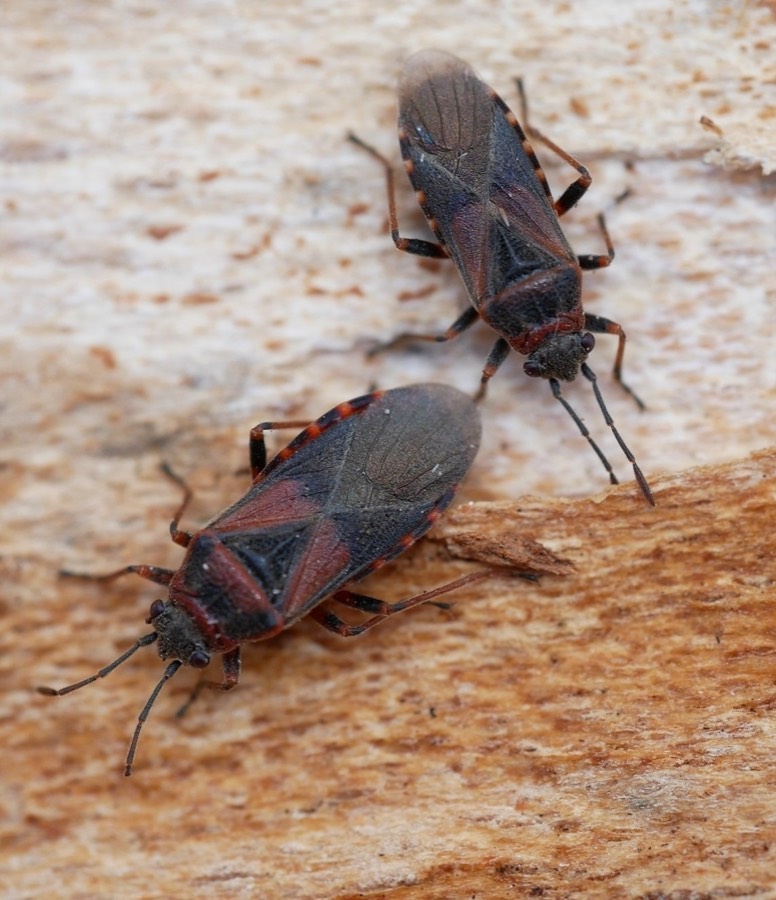
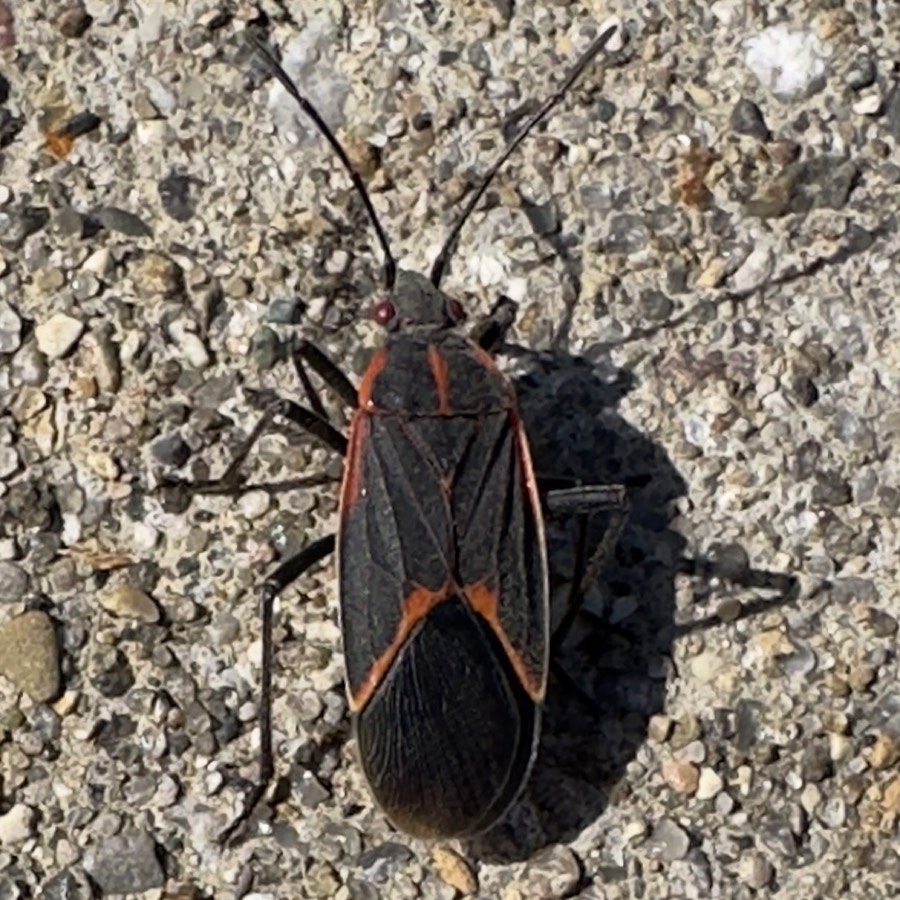
Boxelder bug: black with red-orange lines, swarms warm south and west walls in fall. Elm seed bug: smaller, brownish, peaks early-to-mid summer, and gives off an odor when crushed.
Does it matter?
No. They don’t bite, sting, damage anything, or breed indoors. Pure annoyance.
The school-specific problem
They peak on south and west walls in fall — exactly when school starts and parents are on campus. Expect the calls. Do not let anyone fog the building.
DIY or pro?
Vacuum the ones inside; seal entry points, which is the real fix. The only treatment that earns its keep is an exterior perimeter band — never an interior or whole-tree spray.
Threshold
It’s a volume and comfort complaint, never a health or damage one.
The two nuisance invaders on a sunny wall
Boxelder bug, black with red-orange lines, on a sunlit wallBoxelder bug · black with red-orange lines
Elm seed bug, smaller and brownishElm seed bug · smaller, brownish
Neither one bites, stings, damages anything, or breeds indoors. Boxelder bugs peak on warm south and west walls in fall; elm seed bugs peak in early-to-mid summer and smell when crushed.Photos via iNaturalist: boxelder bug (CC0); elm seed bug © Toby (CC BY).
Earwigs, Millipedes & Centipedesthe moisture wanderers
Leave itDIYReport it
What it is
Earwigs are the ones with the pincers on the back end — alarming, and functionally harmless. Millipedes are slow with many legs and curl into a coil when disturbed. Centipedes are fast, flatter, with fewer legs per segment.
Where they come from
All three are moisture-driven outdoor organisms that wander in. Mulch against a foundation, damp window wells, irrigation overspray, and leaf litter are the sources.
Does it matter?
No. The pincers don’t do anything. Centipedes can deliver a minor pinch if handled, which nobody does.
DIY or pro?
Pull mulch back from the building, fix the irrigation that’s wetting the foundation, clean out window wells, and seal the threshold gaps. Interior spraying is pointless — they’re dying in your building anyway; they can’t live there.
Threshold
Repeated entry at one location means a moisture or gap problem at that location.
The three moisture wanderers, side by side
Photo to comeEarwig — showing the pincers on the back end
Photo to comeMillipede — slow, many legs, coiled
Photo to comeCentipede — flatter, fast, fewer legs per segment
All three are telling you the same thing. Earwig pincers, a coiled millipede, and a fast flat centipede all mean moisture and a gap at the threshold, not an indoor population — none of them can live in your building.
Cluster FliesPollenia — the winter window fly
Leave itDIYReport it
What it is
Slightly larger and more sluggish than a house fly, with golden hairs on the thorax. They appear indoors on warm winter days, often in numbers, usually at upper-floor windows and in attics.
Where they came from
They overwinter in wall voids and attics, having come in the previous fall. They didn’t breed in your building — they breed in soil, in earthworms, outdoors.
DIY or pro?
Vacuum. That’s it. Treating a wall void full of cluster flies creates a dermestid beetle problem as the carcasses feed carpet beetles. Exclusion in the fall prevents next winter’s population.
Threshold
Nuisance only. Large numbers means sealing the building envelope before next fall.
Photo to comeCluster fly — golden hairs on the thorax, at an upper-floor window in winter
Larger and more sluggish than a house fly, with golden hairs on the thorax. Finding them at an upper window on a warm winter day means they overwintered in the wall, not that anything is breeding in the building.
3 Rodents

Mice & Rats

Trap it or bait it. That’s the whole menu.

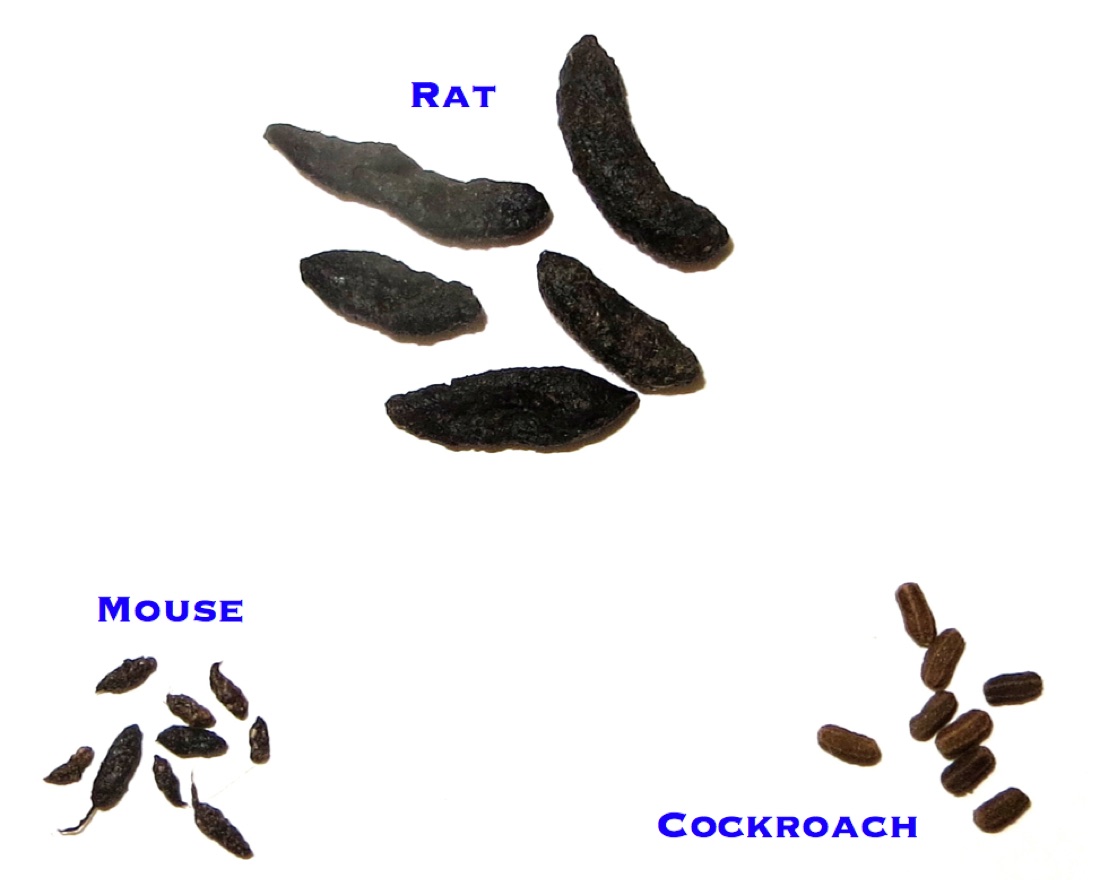
Tell the maker by the dropping Comparison of rat, mouse, and cockroach droppings on a white background, showing relative size and shape
Size and shape name the maker. Rat droppings are the largest, up to about three-quarters of an inch; house-mouse droppings are small and rice-grain sized, under a quarter inch; cockroach droppings are tiny, ridged, and blunt-ended. (Among rats, Norway droppings have blunt ends and roof-rat droppings are pointed — see the entries below.)Image provided by Falcon Pest Control.
House MouseMus musculus
Watch itDIY-ableReport it
What it is
Small, gray-brown, big ears, slender tail. Droppings are rice-grain sized, under a quarter inch, and scattered rather than piled.
Does it matter?
Yes once inside. They contaminate food and surfaces, gnaw, and breed quickly.
DIY or pro?
Staff can legally set snap traps and tamper-resistant stations. The lasting fix is exclusion — seal gaps down to a quarter inch; a mouse fits through a hole the size of a dime. Recurring or building-wide is a program.
Protected?
No.
Threshold
Any evidence in a kitchen, serving line, cafeteria, or classroom is a same-day response. Those are the high-stakes rooms. Elsewhere in the building, first solid evidence starts trapping.
Norway RatRattus norvegicus — the burrower
Act on itLicensed proReport it
What it is
Stocky, brown, blunt nose, tail shorter than the body. Burrows along foundations, under slabs, in woodpiles, near dumpsters and water. Droppings about three-quarters of an inch with blunt ends.
Does it matter?
Seriously, yes. Gnaws wiring — a genuine fire risk in an occupied school — undermines slabs and walkways, and carries disease.
DIY or pro?
Professional program work. Coordinated baiting in tamper-resistant stations, trapping, exclusion, and harborage cleanup together.
Protected?
No.
Threshold
Any confirmed rat anywhere on a school campus is an immediate professional response. Rats do not stay a small problem, and seeing one in daylight means the population is already high.
Roof RatRattus rattus — the climber, increasing along the Wasatch Front
Act on itLicensed proReport it
What it is
Sleeker than a Norway rat, dark, tail longer than the body, an agile climber. Lives high — attics, soffits, roof lines, trees. Enters through vents, HVAC penetrations, and branches overhanging the roof. Droppings about half an inch with pointed ends.
The school-specific access route
Mature trees touching a roofline are a bridge. Schools with established landscaping and flat roofs with parapet walls are the most exposed configuration in the valley.
DIY or pro?
Professional. The win is sealing elevated entry points plus trapping. Trim limbs back from rooflines as prevention.
Protected?
No.
Threshold
Noises overhead, gnaw damage at the roofline, or droppings in an attic or above a ceiling grid means act now.
Look-alike: roof rat vs Norway rat
Photo to comeRoof rat — sleek, dark, tail longer than the body
Photo to comeNorway rat — stocky, blunt nose, tail shorter than the body
The tail settles it. Longer than the body and living high is a roof rat; shorter than the body and burrowing at grade is a Norway rat. The species tells you whether to look up or look down.
Deer MousePeromyscus — the hantavirus one
Act on itSpecial cleanupReport it
What it is
Bicolored — brown on top, clean white belly and feet — with larger eyes than a house mouse. Found in bench and foothill schools, and in sheds, garages, storage buildings, and outbuildings rather than deep inside occupied space.
Does it matter?
Yes, and differently. This is the one that can carry hantavirus. The risk is in disturbing droppings and nests in enclosed, unventilated spaces — a storage shed opened in August is the exact scenario.
The cleanup is the part to get right
Never sweep or vacuum deer mouse droppings in an enclosed space. Air the space out first. Wet everything down with a 1:10 bleach solution and let it sit. Use proper respiratory protection for heavy contamination. Bag and dispose.

Commensal house mice and rats don’t carry hantavirus — but use the same precautions anyway, because you’re often not certain which you have.
Protected?
No — but the cleanup precautions are non-negotiable.
Threshold
Droppings in a closed shed, storage room, portable, or seasonal building means stop and use the wet-cleanup protocol before anyone touches anything.
Photo to comeDeer mouse — showing the bicolor coat and clean white feet
Brown on top, clean white belly and feet. That contrast is the whole identification, and it is the difference between an ordinary trapping job and a wet-method cleanup with respiratory protection.
The only two control realities — and how to set them Trap it or bait it. That’s the whole menu. A snap trap goes perpendicular to the wall with the trigger end touching it (rodents run along walls), baited with a dab of peanut butter — not a pile. A tamper-resistant station sits flush against a wall or foundation where you see activity. The legal, no-license set for a school: put a baited snap trap inside an anchored station — the station is just a tamper-resistant box that anyone can buy, the snap trap does the work, and students can’t reach it.
4 Athletic Fields, Playgrounds & Grounds

Where a Burrow Is a Liability, Not a Landscaping Complaint

Read the hole — it tells you what’s living in your field.

The difference from a commercial property: children run across this ground at speed without looking down. A hole that’s cosmetic on an office lawn is a broken ankle on a soccer field, and a ground nest that’s a nuisance at a business is a mass sting event at recess.

Pocket GopherThomomys — the field-wrecker
Act on itLicensed proGroundsReport it
The hole
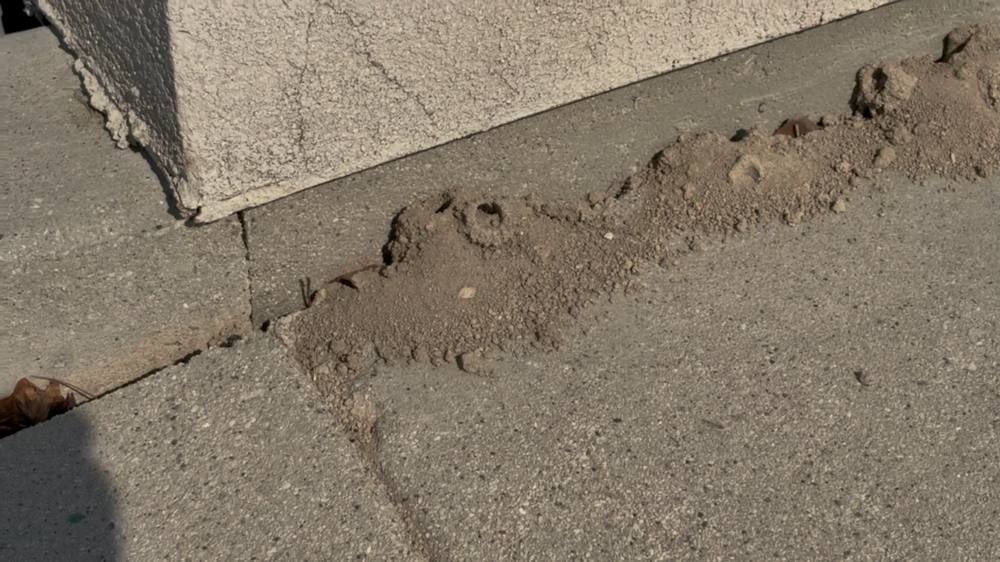
Fan- or horseshoe-shaped soil mounds with the hole plugged off to one side. No open hole most of the time — they backfill. Mounds appear in a line as the tunnel extends.
Does it matter?
On a school field, more than on a lawn. They chew irrigation lines and roots, and the mounds and collapsed tunnels are a trip and ankle hazard on any surface students run on.
DIY or pro?
Trapping and baiting are the control methods, and baiting on school property is licensed work. This is core pest control, not a groundskeeping fix.
Protected?
No. Controllable at any time. Utah Admin. Code R657-3b-9(7).
Threshold
Any active mound on a field, playground, or track is act-now. On ornamental landscape away from student use, fresh mounds spreading is the cue.
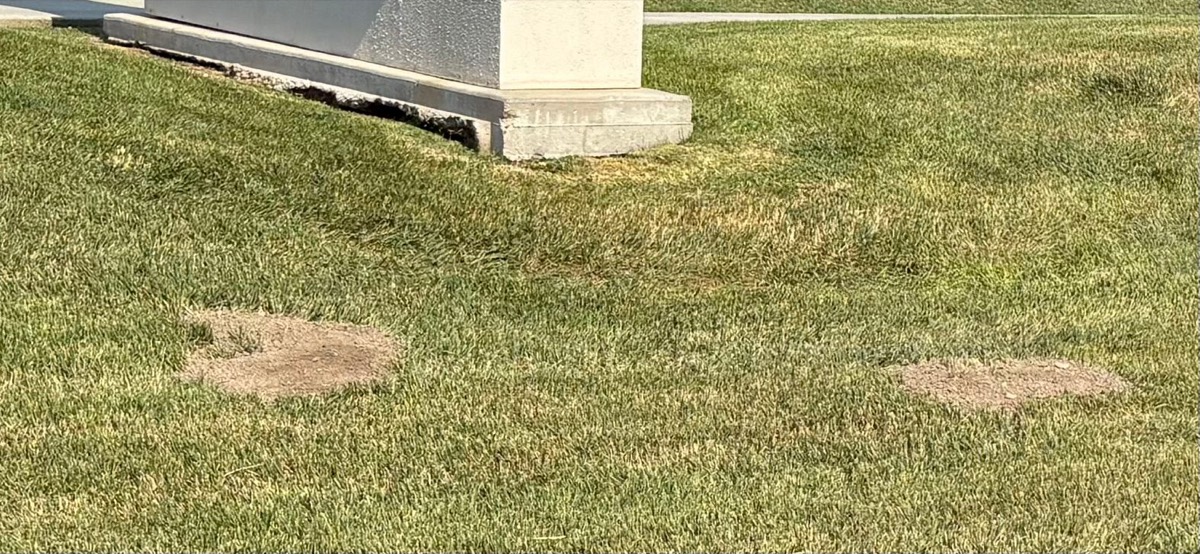
Two pocket gopher mounds, fresh soil pushed up across a lawn
Gopher mounds. Fresh soil pushed up across the turf, the burrow plugged off to one side with no open hole and no surface runways. On a field students run on, a fresh mound is act-now.Photo: Falcon Pest Control.
VoleMicrotus — “meadow mouse”
Watch itDIY-ableGroundsReport it
The hole
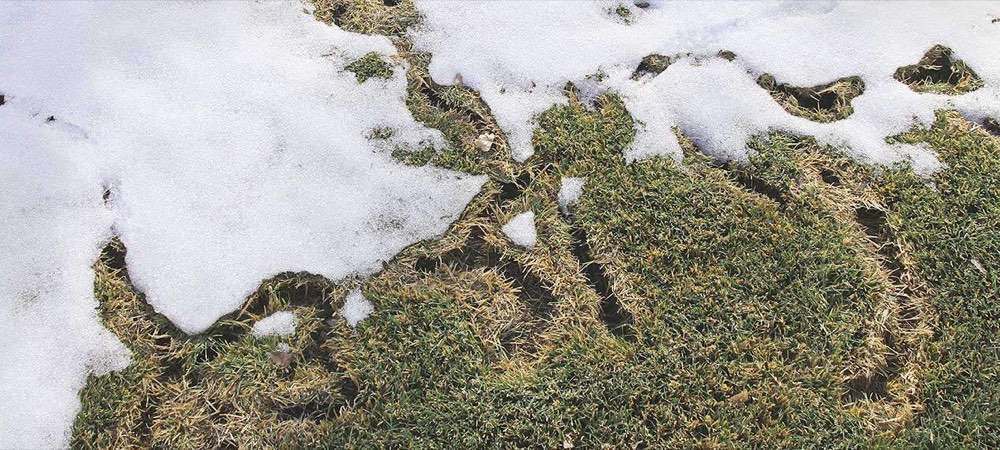
Small open holes about an inch and a half across with no soil mound, connected by surface runways — worn paths in the grass. Clearest right after snowmelt, when a winter’s worth of damage appears all at once.
Does it matter?
For turf and landscaping, yes. They girdle roots, bark, bulbs, and groundcover, and the runways scar fields.
DIY or pro?
Staff can legally trap. A peanut butter snap trap set right at a runway or hole works. Reducing dense mulch and groundcover near buildings removes the cover they need. A large or persistent infestation becomes a program.
Protected?
No. Utah Admin. Code R657-19; R657-3b-9.
Threshold
Runways across a field or repeat plant damage moves it from spot-trapping to a managed program.
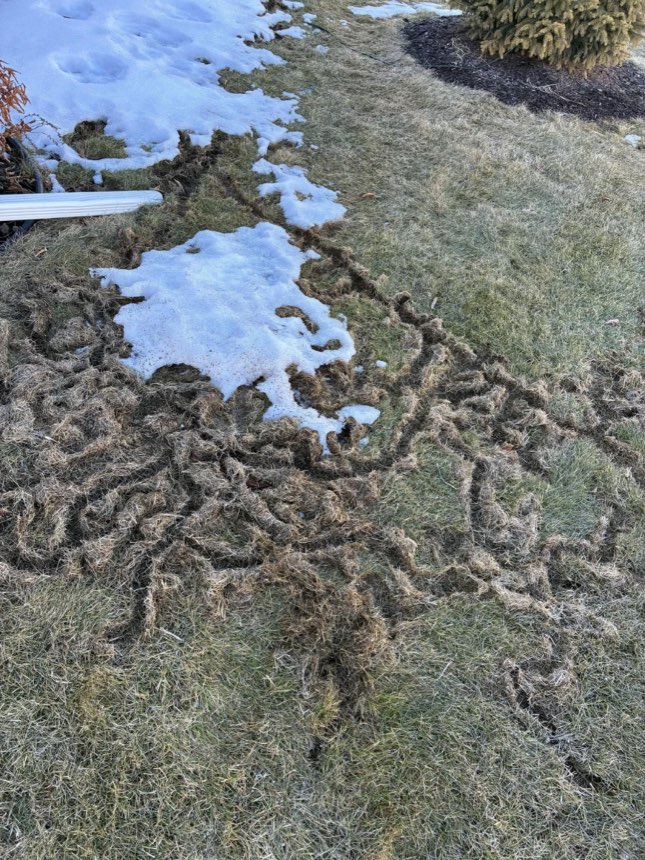
Vole surface runways at snowmelt
A maze of vole surface runways winding across a lawn, revealed as the snow melts
Close view of vole runways and clean holes in the turf at the snow line
Vole runways. Small clean holes with no soil mound, joined by worn surface paths in the grass, clearest right after snowmelt — which is why a field can look fine in February and ruined in March.Photos: Falcon Pest Control, Wasatch Front.
Ground SquirrelUinta and rock squirrels — the schoolyard burrower
Act on itLicensed proGroundsReport it
The hole
Open burrow entrances two to four inches across, often with a scattered apron of soil, frequently under a sidewalk edge, a portable classroom, a retaining wall, or the base of playground equipment.
Does it matter?
Yes, for two reasons most people only think of one of. The burrows undermine sidewalks, slabs, and playground footings, and they’re a leg-breaking hazard on any surface children run on. They also chew irrigation.
The school-specific one
Ground squirrels in a schoolyard become habituated to children and food quickly, and a habituated squirrel that approaches students is a bite and rabies-exposure conversation nobody wants to have.
DIY or pro?
Professional. Burrow work, exclusion under structures, and removing the food source. Stop students feeding them — that’s a policy fix, and it’s most of the problem.
Protected?
No.
Threshold
Any active burrow under a sidewalk, slab, portable, or play structure is act-now. Burrows in open ground away from student use can be monitored.
Photo to comeGround squirrel burrow undercutting a sidewalk or slab edge
The burrow under the edge is the one that matters. An open two-to-four-inch hole with a soil apron, tucked under a walk, a portable, or a play structure, is undermining a footing and waiting for an ankle.
Yellowjacket Ground Nestcross-reference — full entry in §5
Act on itLicensed proGrounds
Why it’s listed here
Called out separately because of where it happens. A yellowjacket ground nest in a field, along a fence line, or at the edge of a play area is the highest-risk pest configuration on a school campus, because it’s invisible until someone runs over it and the colony defends in numbers.
What to look for
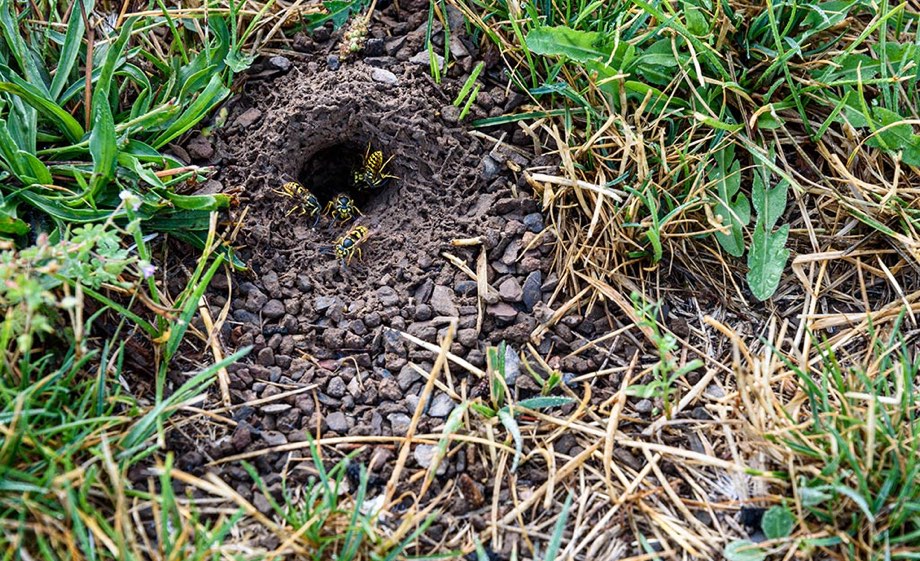
Walk the fields before the season starts. Watch for steady two-way traffic in and out of a single hole in the ground. Full details in §5, Stinging & Flying.
Photo to comeYellowjacket ground-nest entrance in turf, with traffic at the hole
Steady two-way traffic at one hole in the ground. That is the read, and it is the one worth walking a field for before the season starts.
SkunkMephitis mephitis — the rabies-vector digger
Watch itWildlife controlGroundsReport it
What it is
Dens under portables, decks, sheds, and stair landings. Digs cone-shaped holes in turf hunting grubs — that’s the sign you’ll see first, usually overnight on an irrigated field.
Health note
A primary rabies carrier in this region. Hands off — this is a professional matter, not a DIY trapping job, and no staff member should approach one.
DIY or pro?
Licensed wildlife control operator. The durable fix is exclusion — screen and seal under portables, decks, and sheds — plus addressing the grub problem drawing them to the field in the first place.
Threshold
Denning under any structure, or any daytime or disoriented behavior, is a professional call immediately.
Photo to comeCone-shaped skunk grub-hunting holes across irrigated turf
Small cone-shaped divots that appeared overnight. That is a skunk working an irrigated field for grubs, and the grubs are the reason it keeps coming back.
Sand Wasp BurrowBembix — cross-reference, full entry in §5
Leave itDIYGrounds
The hole
Small holes in bare, dry, sandy soil with a flying insect coming and going — not a mammal. This is the one that gets misread as a vole burrow and panics a playground supervisor. If a wasp is working the hole, it’s a solitary sand wasp and it’s harmless.
What to do
Leave it, or improve the turf so the soil isn’t bare and dry. Full details in §5, Stinging & Flying.
Yellow-Bellied MarmotMarmota flaviventris — a bench and foothill issue
Watch itLicensed proGrounds
The hole
Large burrows under rock piles, decks, retaining walls, and slopes at bench and foothill schools. The animal is house-cat sized.
Does it matter?
Yes when the burrows undermine structures, walls, or walkways.
DIY or pro?
Professional removal plus exclusion — sealing under the structure is what makes it stick.
Threshold
Active burrowing under any structure or retaining wall means handle it before the undermining gets expensive.
The 10-second burrow readMound + plugged hole = gopher. Clean hole + surface runways, no mound = vole. Open 2–4″ hole with a soil apron, often under an edge = ground squirrel. Hole with a wasp working it = sand wasp. Cone-shaped divots overnight = skunk after grubs. Giant hole under a structure on the bench = marmot.
5 Stinging & Flying

The One Category Where a Mistake Sends a Child to the Hospital

Location decides this, not species and not size.

The consequence in a school isn’t property damage — it’s a sting to a child who may not know they’re allergic. Any active nest near a door students use, a playground, a field, or a lunch area is acted on immediately regardless of species.

Tell the nest at a glance
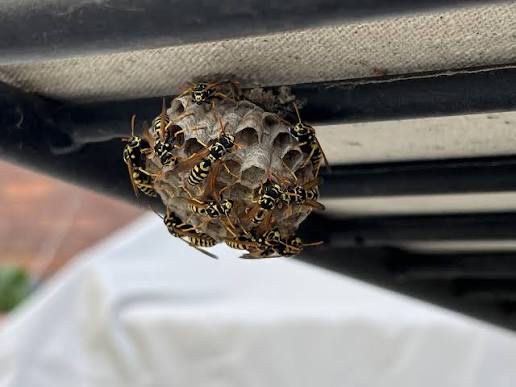
Open, single-layer umbrella paper-wasp comb with exposed cellsPaper wasp · open comb
Yellowjacket ground-nest entrance holeYellowjacket · ground / enclosed
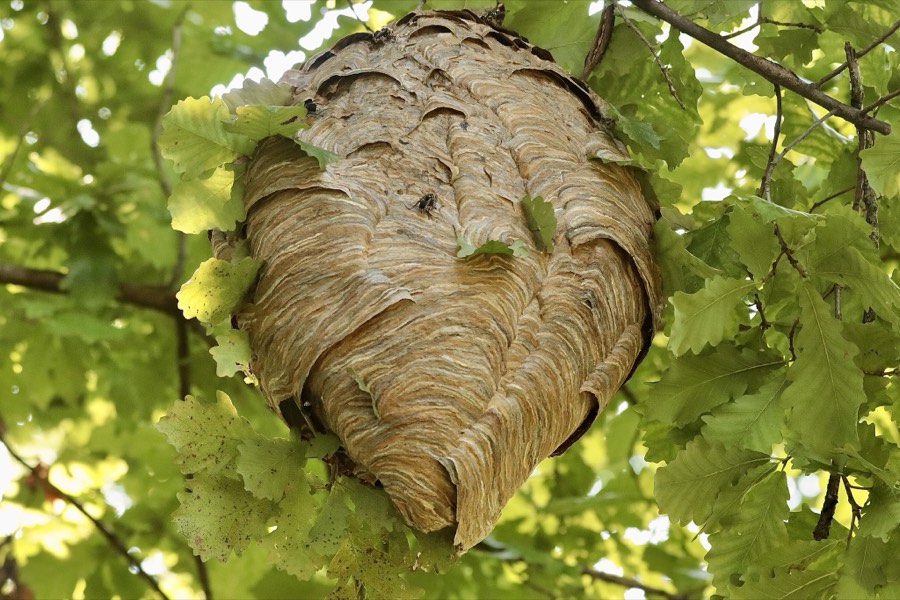
Bald-faced hornet gray enclosed football nestBald-faced hornet · gray football
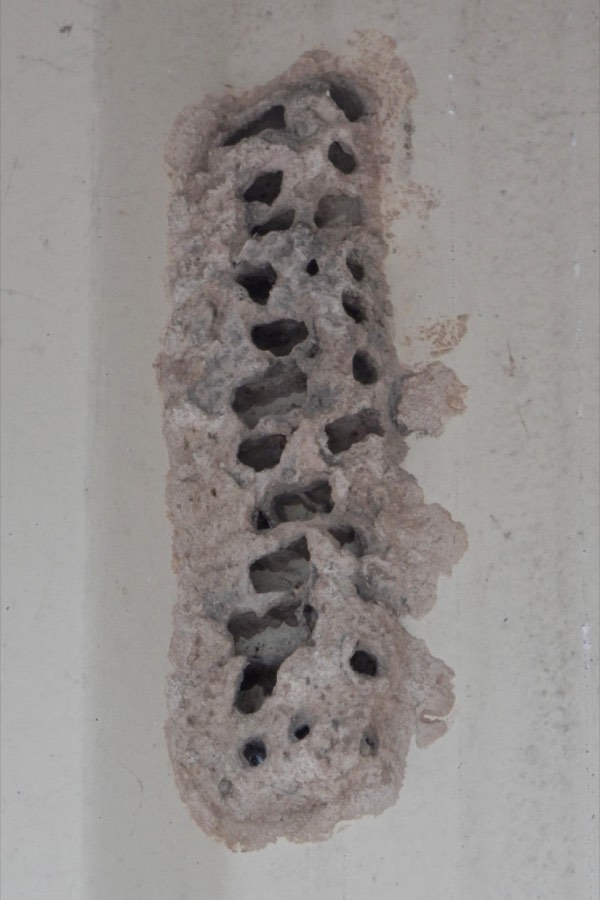
Hard mud dauber tubes on a wallMud dauber · mud tubes
Open comb is a paper wasp. A closed ball or a ground hole is a yellowjacket; a gray football is a bald-faced hornet; hard mud tubes are a harmless mud dauber.Photos: paper wasp & yellowjacket, Falcon Pest Control. Others via iNaturalist / Wikimedia Commons: bald-faced hornet © Rev. Lee A. Payne Jr. (CC BY); mud dauber © Ryan Hodnett (CC BY-SA 4.0).
Paper WaspsPolistes — incl. the very common European paper wasp
Watch itDIY
What it is
Open umbrella comb under eaves, in playground equipment, in light fixtures, on signage. Open comb equals paper wasp.
Does it matter?
Low, unless it’s at a door students use, a play structure, or a lunch area. They’ll sting if the nest is disturbed, but they’re not out hunting people.
DIY or pro?
DIY. A pole sweeper knocks it down — that’s the whole method. Dawn or dusk if you want them home first.
Protected?
No — but confirm it’s a wasp, not a honeybee, before anything.
Threshold
Anything within reach of students, or at a door, comes down regardless of size.
YellowjacketsVespula — the exception to everything above
Act on itLicensed pro
What it is
Closed paper ball or underground. Not open comb. Aggressive scavengers — they show up at lunch, at trash cans, at the concession stand.
Does it matter?
Yes. The one stinging insect that’s a genuine hazard, and the one that stings repeatedly and in numbers.
DIY or pro?
Pro. You can’t sweep a nest that’s underground or inside a wall void, and provoking one is how people get hurt.
Protected?
No.
Threshold
Any active nest anywhere on campus during the school year.
Bald-Faced HornetsDolichovespula maculata — a yellowjacket relative, not a true hornet
Act on itLicensed pro
What it is
The gray football nest — a fully enclosed papery envelope in a tree, on a soffit, or under an overhang. Black and white, larger than a yellowjacket.
Does it matter?
Yes near people. They defend that enclosed nest aggressively.
DIY or pro?
Pro.
Protected?
No.
Threshold
Anything near a walkway, entrance, field, or play area. A high nest well away from student traffic can be left to die off in fall.
Mud DaubersSceliphron / organ-pipe daubers
Leave itDIY
What it is
Hard mud tubes on walls and under overhangs. Solitary, almost never sting, actually spider hunters.
DIY or pro?
Scrape and repaint. Pure appearance complaint.
Protected?
No.
Threshold
It’s an appearance call, never a safety one.
HoneybeesApis mellifera — the one stinging insect you don’t exterminate
Watch itRelocate, don’t kill
What it is
Fuzzy and amber, not glossy. Don’t spray them.
What to do
A swarm usually moves on within a day or two; an established colony in a wall needs a beekeeper. Schools are exactly where this gets handled badly — confirm it’s a wasp before anyone does anything.
Threshold
A passing swarm: wait a day, keep students clear. A colony living in a structure: get it removed before it establishes comb.
Sand Wasps & Solitary DiggersBembix and kin — also listed in §4
Leave itDIY
What it is
Individual wasps working small holes in bare, dry soil. Solitary, not defending a colony, essentially harmless.
DIY or pro?
The fix is cultural, not chemical — thicker turf and better irrigation pushes them out. This is the one you talk a playground supervisor down from.
Threshold
Rarely crosses one. The key confusion to resolve: a digger hole gets mistaken for a vole burrow — a hole with a single wasp working it is a wasp, not a rodent (full burrow read in §4).
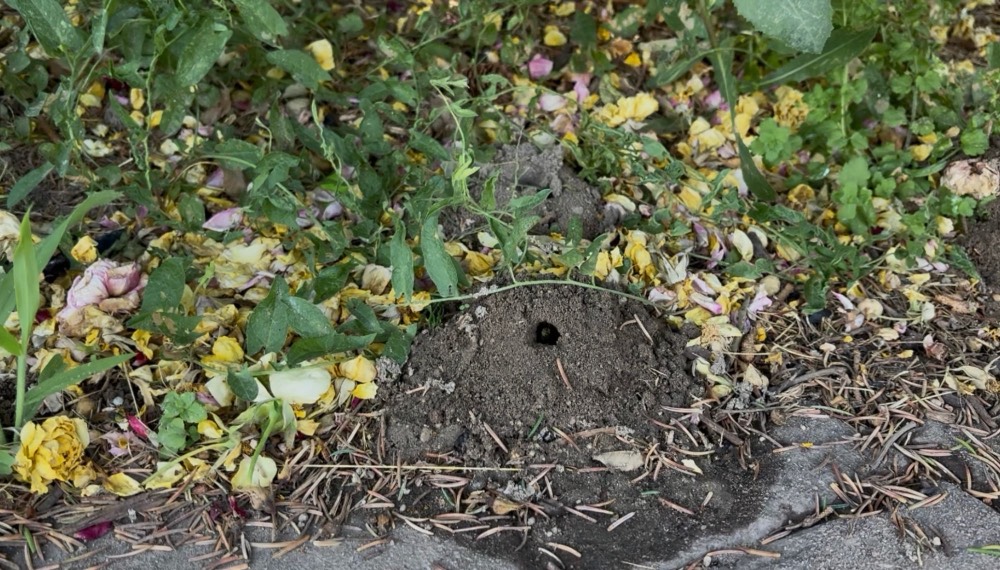
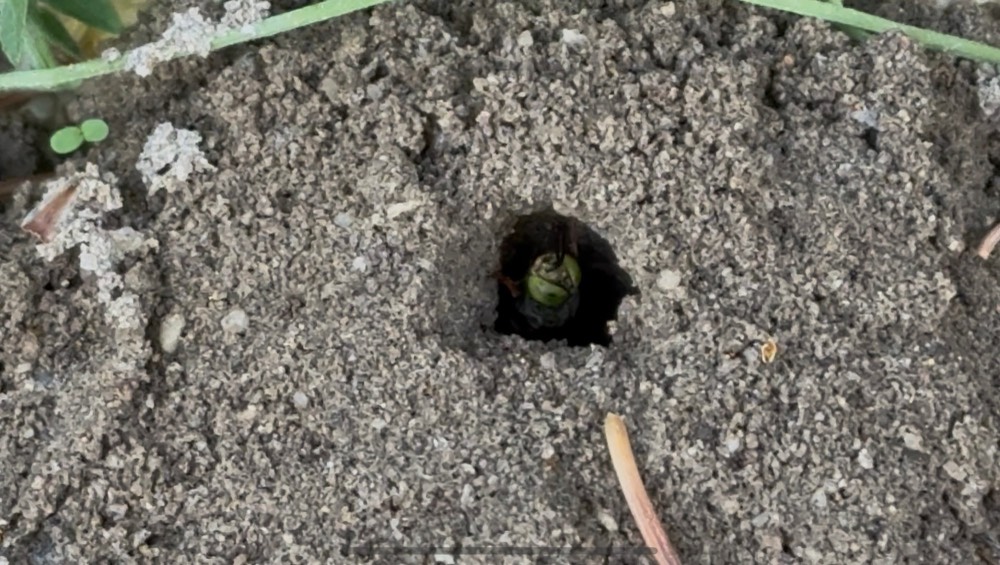
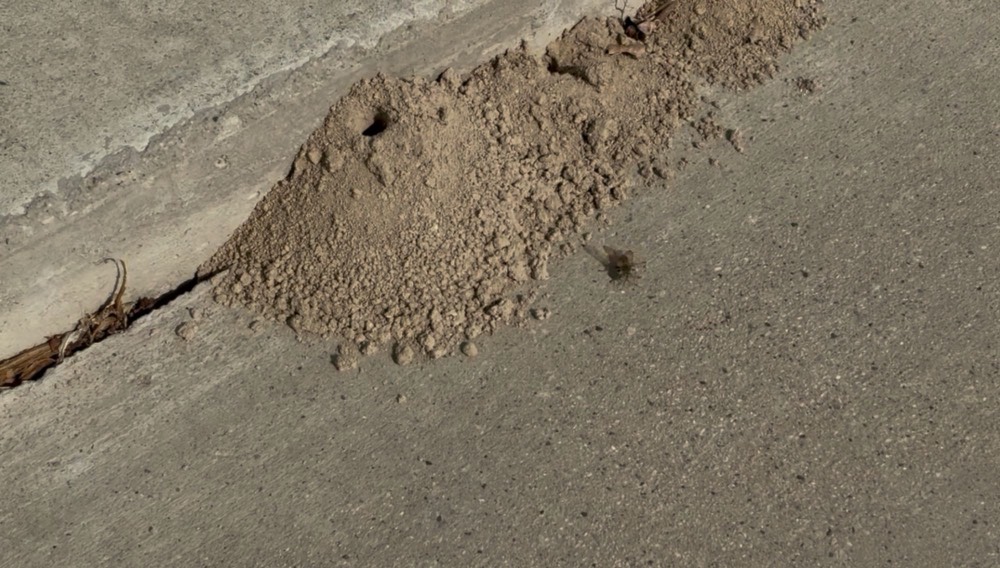
Sand wasp diggings — a wasp at the hole, not a rodent
Sand wasp mound with the wasp at the hole entranceMound, wasp at the hole
Close view of a single sand wasp working its burrowOne wasp working the hole
Sand tailing pushed out along a concrete crack by a digging waspTailing along a crack
Sand wasp diggings along a foundation edgeDiggings along a foundation
The tell is the wasp. A small hole in bare, dry soil with a single wasp coming and going is a harmless sand wasp, not a rodent — the read that separates it from a vole.Photos: Falcon Pest Control.
Myth to kill on the spot“Murder hornets” are not here. The northern giant hornet was only ever found in the Pacific Northwest and was declared eradicated. The big intimidating thing someone photographed is a bald-faced hornet or a sand wasp.
6 Spiders

Which One Is Actually a Concern

In Utah, almost all of them are “just a spider.”

Kill this myth firstThere are no brown recluses in Utah. The range doesn’t reach here, and decades of sightings have never established a population. This is the single most useful thing you can tell a worried parent.
Western Black WidowLatrodectus hesperus — the one that warrants real respect
Act on itDIY-able
What it is
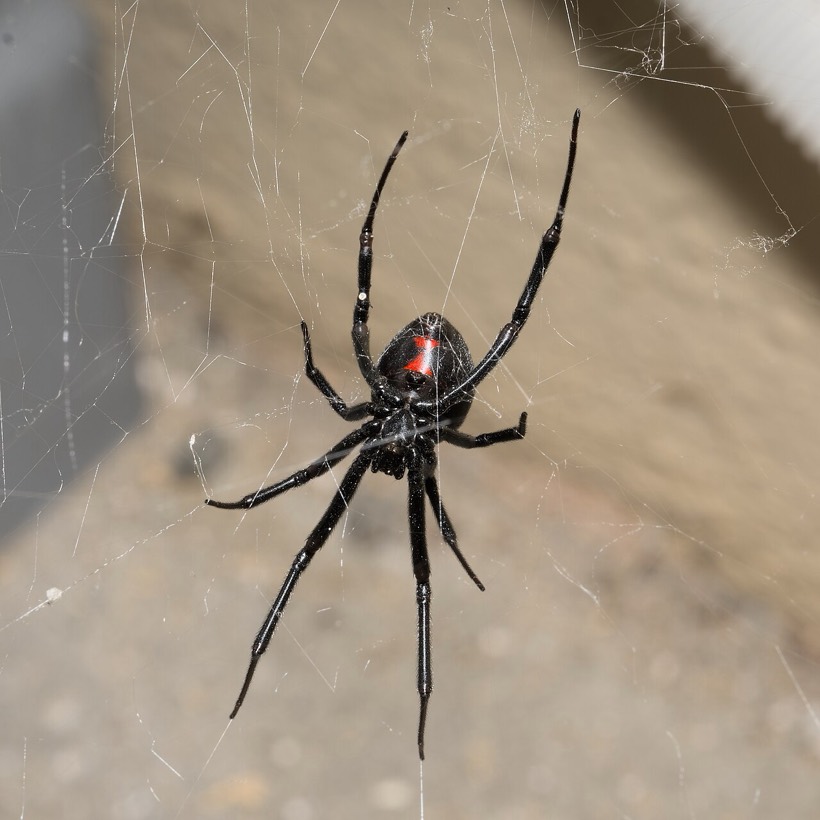
Glossy black, red hourglass underneath, messy irregular web in dark undisturbed places.
The school-specific locations
Under playground equipment, inside the frame tubing, under bleachers and benches, in electrical and irrigation boxes, in window wells, and inside ground bait stations. Every one of those is a place a child reaches into without looking.
DIY or pro?
Knock down webs and egg sacs and reduce harborage and clutter; staff can do that with no license. In places students reach blindly, a treatment program is worth it.
Protected?
No.
Threshold
Widows anywhere students reach blindly is act-now. Walk the playground and bleacher undersides in spring.
Western black widow on its web, glossy black with the red hourglass on the underside of the abdomen
The one that warrants respect. Glossy black with a red hourglass on the underside of the abdomen, in its messy, irregular web. Everything else in Utah is, functionally, just a spider.Image provided by Falcon Pest Control.
Hobo Spiders & Other “Scary” SpidersEratigena agrestis, wolf spiders, etc.
Leave itDIY
What it is
Big, fast, unsettling, and not medically significant.
DIY or pro?
Knock down webs, reduce clutter and exterior lighting, seal entry. The job here is reassurance and a vacuum, not a spray.
Protected?
No.
Threshold
Mostly a comfort issue.
The whole spider message in one lineIf it’s a glossy black spider with a red hourglass in a spot someone reaches into, respect it. Everything else in Utah is, functionally, just a spider.
7 Building Envelope & Wood-Destroying

Only One of These Actually Eats the Building

Know which, because the other two are telling you about water.

Subterranean TermitesReticulitermes — the real structural threat
Act on itLicensed pro
What it is
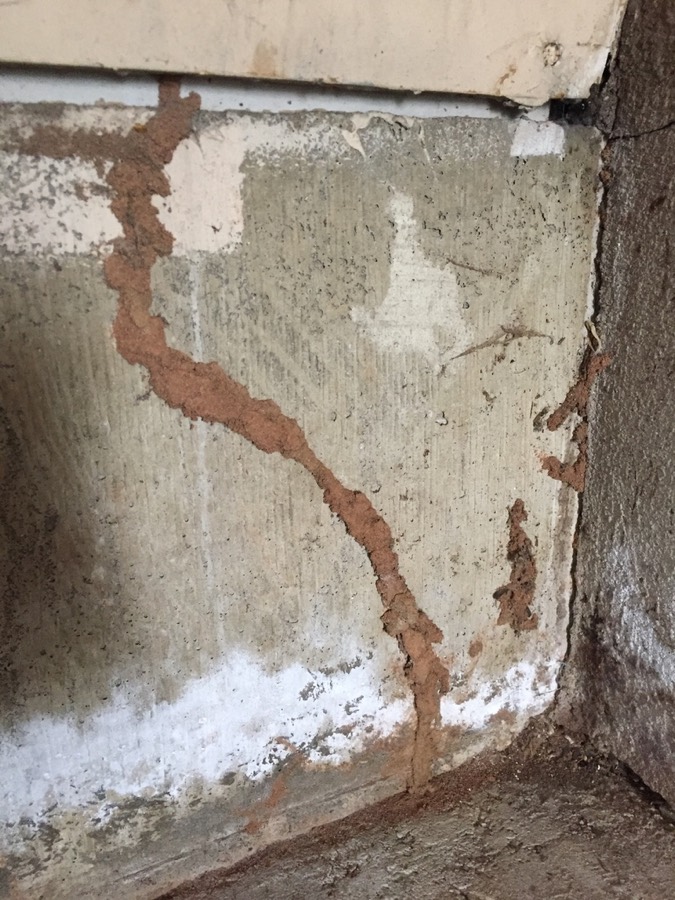
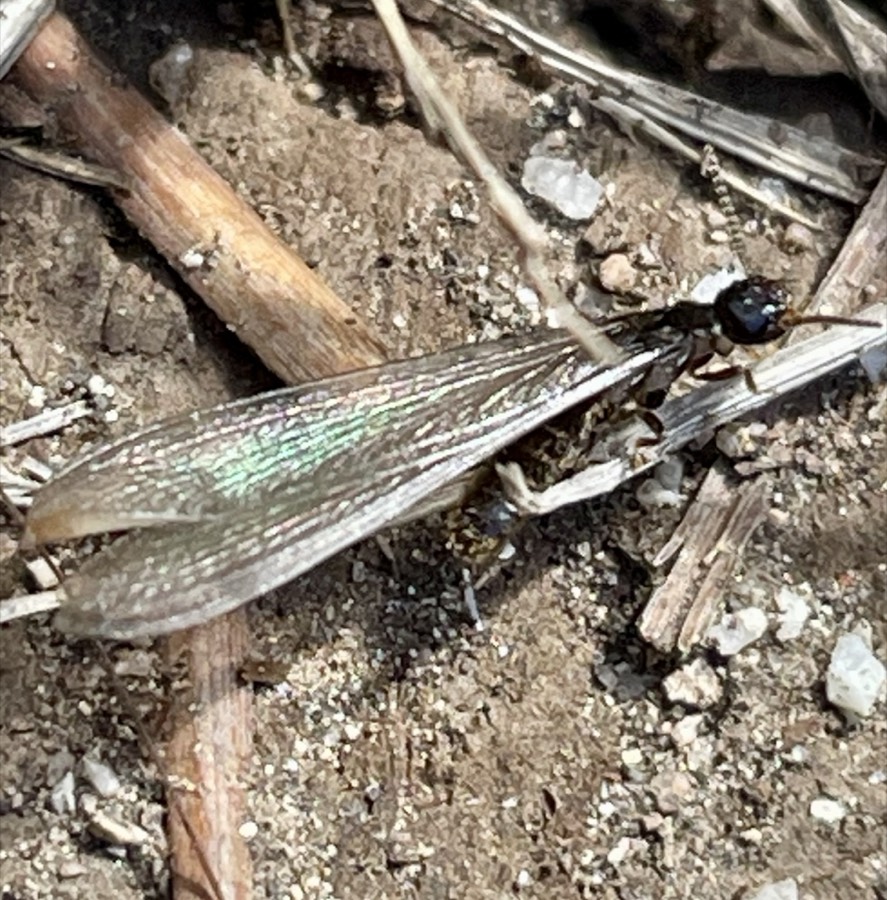
Pale, soft-bodied, live underground and come up through soil contact. Tell-tale signs: pencil-width mud tubes on foundations and crawlspace walls, and a spring swarm of dark winged termites (often mistaken for flying ants — termites have straight bodies, equal-length wings, and straight antennae). Salt Lake County is termite country; it is not in Utah’s termite-exception areas.
Where to look in a school
Portable classrooms sitting on or near grade, planters built against the building, wood chip playground surfacing against a foundation, and irrigation that keeps soil wet against a wall. Wood-to-soil contact plus moisture is the entire risk equation, and schools create both routinely.
DIY or pro?
Professional, always — soil treatment and/or baiting by a licensed applicator, plus reducing wood-to-soil contact and moisture against the structure.
Threshold
Any mud tubes, a swarm, or hollow or damaged structural wood means a professional inspection now.
Subterranean termite ID Pencil-width subterranean termite mud tubes running up a concrete foundation wall
Winged termite: straight body, two pairs of equal-length wings, straight antennaeTermite swarmer · straight waist, equal wings
Winged ant: pinched waist, elbowed antennae, unequal wingsFlying ant · pinched waist, elbowed antennae
The real structural threat. Pencil-width mud tubes on foundations, and a spring swarm of dark winged termites, distinguished from flying ants by the straight body, equal-length wings, and straight antennae.Photos via iNaturalist: mud tubes © Michael K. Oliver (CC BY); termite & ant swarmers (CC0).
Carpenter AntsCamponotus — a moisture signal as much as a pest
Watch itLicensed pro
What it is
Large, often half an inch, black or dark ants. They don’t eat wood — they excavate galleries in wood that’s already wet or rotting, leaving sawdust-like shavings (“frass”) below.
Where the water is, in a school
Large ants indoors plus sawdust-like frass means finding the water. In a school that’s usually a roof leak above a ceiling grid, a failed window seal, or a chronically wet planter.
DIY or pro?
Fix the water source, which is the real fix, and have a pro locate and treat the nest. Surface spraying the trails alone won’t solve it.
Threshold
Big ants indoors plus frass or damp wood means find the moisture and the nest.
Nuisance Antsodorous house ants, pavement ants, etc. — no wood damage
Leave itDIY-able
What it is
The small ants trailing across walks, thresholds, and counters. They do no structural damage.
DIY or pro?
Wipe trails, remove food and moisture, and use a consumer bait so they carry it home. Don’t spray the trail, which splinters the colony. Kitchen-specific handling in §1.
Threshold
It’s a sanitation and appearance call. The key is just knowing it’s not termites or carpenter ants.
The wood-destroying bottom lineTermites destroy sound wood — serious. Carpenter ants exploit wet wood — fix the water. Regular ants damage nothing — just keep them out of the kitchen.
8 Birds

The Three You Can Act On — and Everything You Can’t

Get this one wrong and it’s a federal and a state problem.

Almost every bird in Utah is protected. Only three common pest birds are exempt — and even those come with rules. The safe instinct: assume a bird is protected until you’ve confirmed it’s one of the three.

The school configurations that generate bird problemsCovered walkways and breezeways. Bleachers and press boxes. Loading dock canopies. Rooftop mechanical screens. Stadium light standards. All of them are ledges over places people walk or sit, which is exactly where droppings become a slip and sanitation issue.
Pigeon · European Starling · House Sparrowthe unprotected, non-native pest birds
Watch itLicensed pro
What they are
The three non-native birds that foul buildings, ledges, signage, and walkways with droppings and nesting. (Eurasian collared-dove is also treated as a nuisance, non-protected species in Utah.)
Does it matter?
Yes when droppings accumulate on walkways, seating, equipment, or entrances — an appearance, slip, and sanitation issue, and a corrosion issue on metal and stone over time.
The legal reality
These three can be controlled in Utah without a state certificate or federal permit when they’re damaging property or creating a nuisance — but non-lethal methods must be tried first, all local, state, and federal laws followed, and control done without poison, bait, or explosives. Utah Admin. Code R657-3b-9; R657-3-7.
DIY or pro?
The durable, lawful answer is exclusion and deterrence — netting, spikes, ledge modification, and reproductive baiting programs — which is professional work.
Threshold
Droppings fouling a walkway, entry, or seating area, or persistent roosting or nesting on a building, means move to an exclusion program.
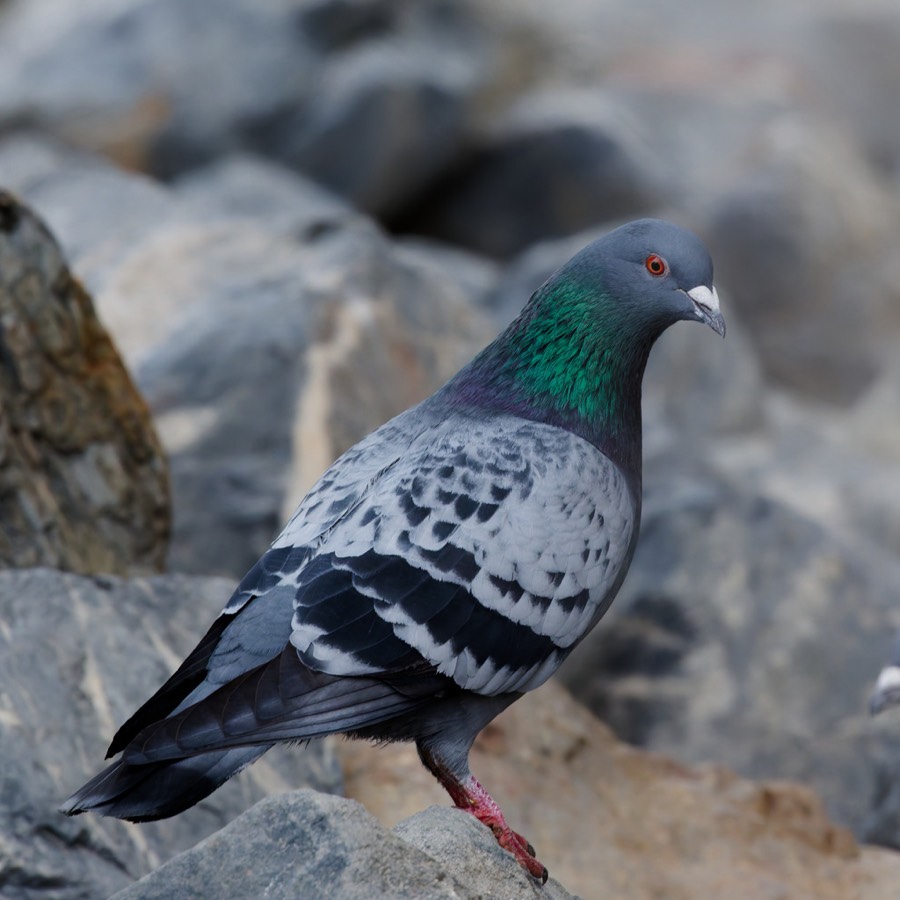
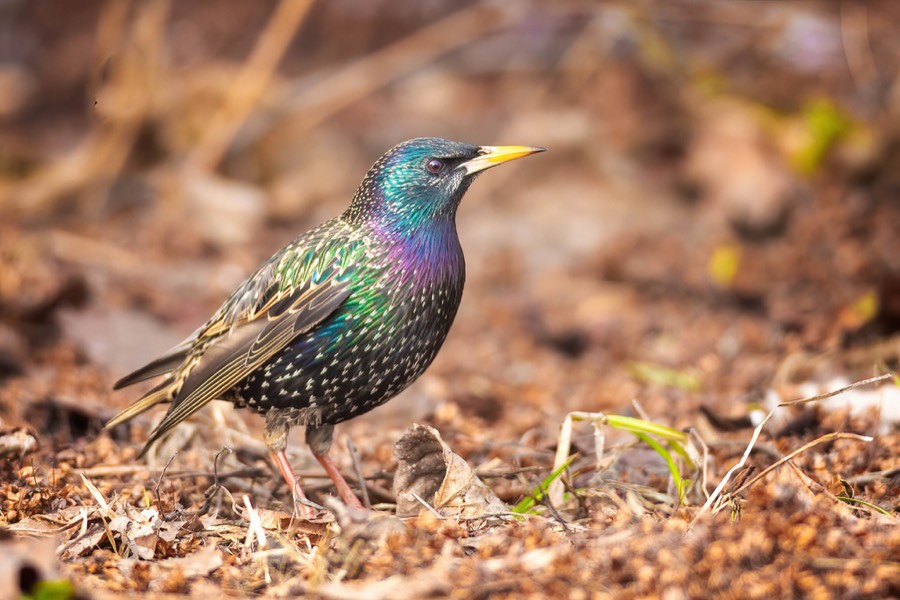
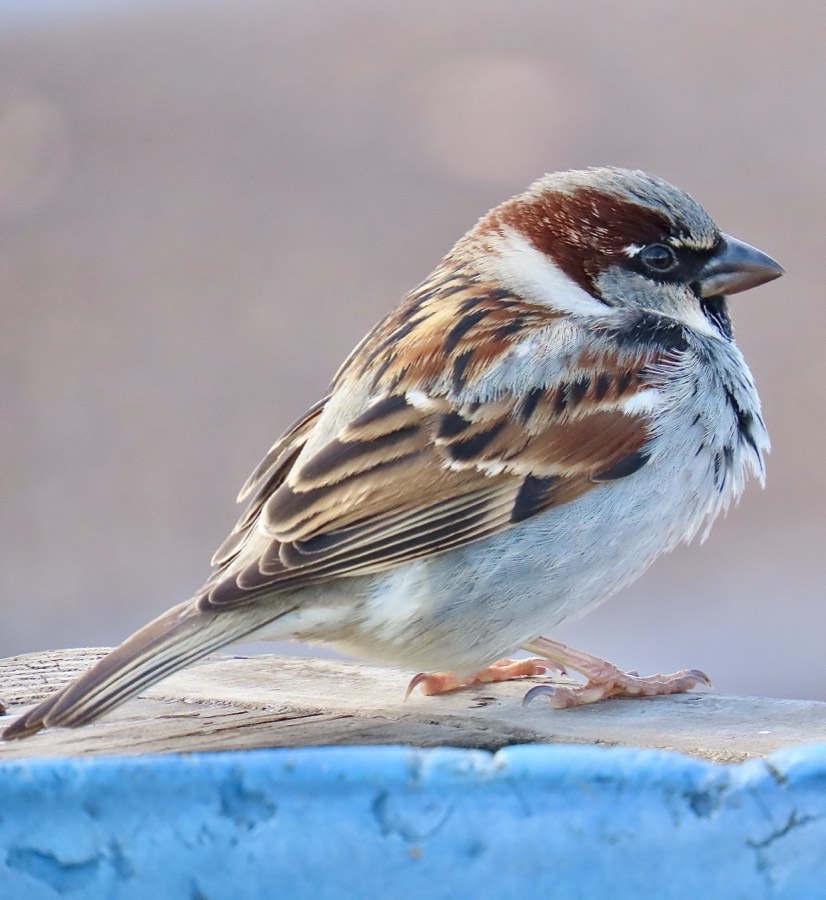
The three unprotected pest birds
Rock pigeonPigeon
European starling in breeding plumageEuropean starling
House sparrow, adult maleHouse sparrow
The non-native three. Pigeon, European starling, and house sparrow are the birds that can be controlled in Utah. Anything else, treat as protected until confirmed.Photos via iNaturalist: pigeon © daughterdad (CC BY); starling © egorbirder (CC BY); house sparrow © aparrot1 (CC0).
Everything Else — Protectedswallows, robins, finches, native sparrows, raptors, geese, etc.
Protected — do not harm
What it is
Every native bird — and that’s nearly all of them.
The legal reality
Protected under the federal Migratory Bird Treaty Act and Utah law. Disturbing an active nest, eggs, or young can be a serious violation. 50 CFR; Utah Admin. Code R657-3.
The swallow trap
Mud nests under eaves and on walls are protected once active. Exclude in March, before they build. A district that waits until April is legally stuck until the young fledge — and a landscaper knocking one down is a violation, not a cleanup.
Threshold
If it’s not a pigeon, starling, or house sparrow, treat it as protected and get guidance before touching a nest.
Bird Remediation — What Works, What’s a Waste
Exclusion (netting, spikes, wire, ledge angling)
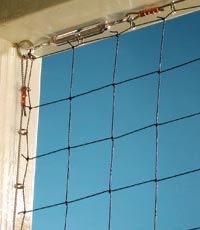
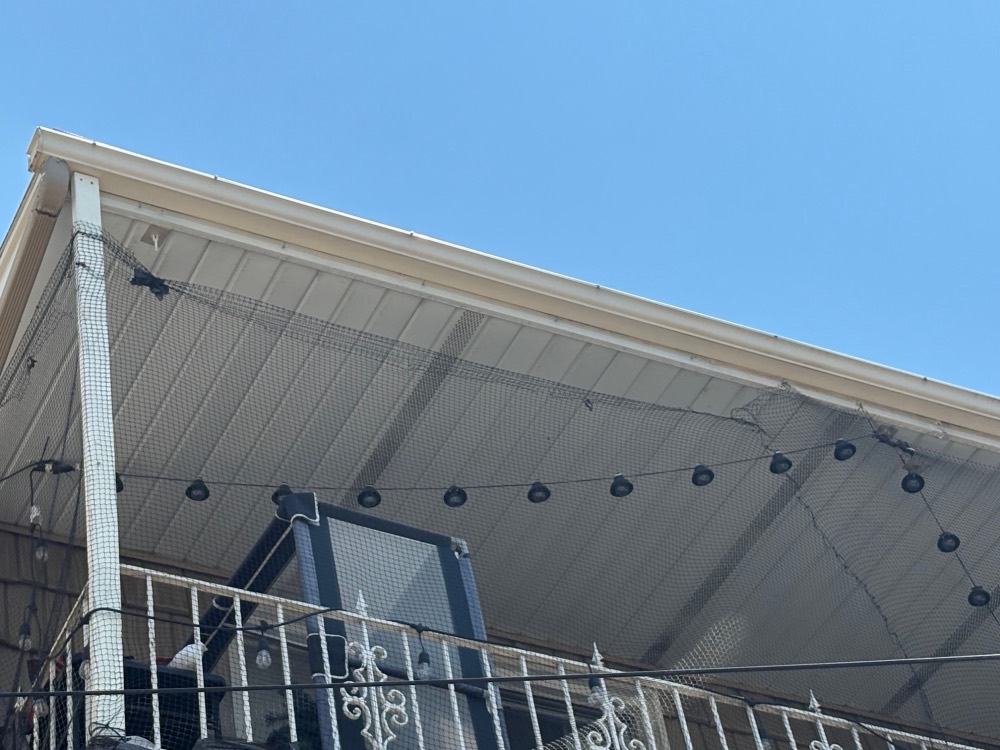
The durable fix. Physically denies birds the surface they want — quality netting can last on the order of ten years. The gold standard — but only if installed correctly. Tight, fully sealed edges are everything; loose or oversized edges let birds in behind the net where they get trapped, which is a worse problem than you started with and has to be torn out and redone. Highest upfront cost, lowest cost over time.
Deterrents (fake owls, scare-eyes, reflective tape, noisemakers, gels)
The category that disappoints. Birds habituate — they quickly learn the plastic owl and the noise are harmless and come right back. Fine as a short-term supplement; never a standalone solution.
Trapping
Right tool, wrong target — usually. Works for resident birds that stay year-round (some sparrows and starlings); useless against mobile pigeon flocks that simply reinvade.
Lethal / toxicants
Restricted, and rarely the answer. Restricted-use, licensed-and-permitted only, with real public-perception problems — and on a school campus, effectively never the path.
The takeaway
Exclude first and exclude right; use birth control where you can tolerate some birds in the meantime; treat deterrents as temporary; don’t bother trapping a flock.
Bird netting: done right vs done wrong
Bird netting installed correctly: a taut, even grid with tightly sealed edgesDone right · tight, fully sealed edges
Bird netting installed poorly: loose and sagging with gaps along the eaveDone wrong · loose edges trap birds
Exclusion only works if the edges are tight. Installed right, netting is an even, taut grid with fully sealed edges. Loose or oversized edges let birds in behind the net where they get trapped — a worse problem than you started with.Photos: Falcon Pest Control.
Bird Birth ControlOvoControl — the source-level option
Managed program
What it is
An EPA-registered bird contraceptive (active ingredient nicarbazin), delivered as a bait the flock eats on a schedule. Not a poison — its acute toxicity is comparable to table sugar, and the effect reverses if baiting stops.
How it works
Treated birds lay eggs that don’t hatch, so the flock shrinks gradually through natural attrition instead of being killed.
Why it’s considered effective
It cuts a pigeon flock by roughly half over a year — a documented field trial in San Diego saw about a 53% decline over twelve months. Endorsed by humane and conservation groups because it addresses reproduction rather than chasing symptoms.
The realities
It’s slow, and it only works with sustained, consistent daily baiting through the breeding season. It fits only where some birds can be tolerated in the meantime, and it pairs best with exclusion.
The expensive bird mistakeKnocking down an active swallow or other native nest — or letting a landscaper do it — is a violation, not a cleanup. The entire game with protected birds is excluding them before they nest. Once eggs are present, your options narrow to waiting and then preventing next year.
9 Bats & Wildlife

When It’s Not a Pest — It’s Wildlife

Pest control, animal control, or DWR? Some of these you legally cannot kill.

Batsall 18 Utah species — protected, and timing-restricted
Protected — cannot killPermitted operator
What it is
A single bat that blunders into an occupied space, or a maternity colony roosting in an attic or soffit — through ridge vents, soffit gaps, and flashing. Little brown and big brown bats are the usual valley species.
The legal reality
Every Utah bat species is protected — it is illegal to kill them. A colony in a structure must be handled by exclusion (one-way devices that let bats out but not back in), then sealing — never poison. Utah DWR.
The timing trap, on a school calendar
Bat maternity season runs roughly mid-May through mid-August — which is exactly summer break, the window when a district would naturally schedule building work. Sealing an attic in June traps flightless pups inside: illegal, and it leaves dead animals in the wall and adults pushing into occupied space.

Exclusion happens before mid-May or after mid-August. Plan it into the maintenance calendar deliberately, because the obvious time is the wrong time.
DIY or pro?
A single bat in a room can be released: open a window, kill the lights, clear the room, and let it fly out — never handle a bat bare-handed (rabies risk), and never let a student near it. A colony requires a DWR-permitted wildlife-control operator.
Threshold
One bat indoors means release it and log it. A colony, guano accumulation, or repeat entries means a permitted operator, on DWR’s schedule.
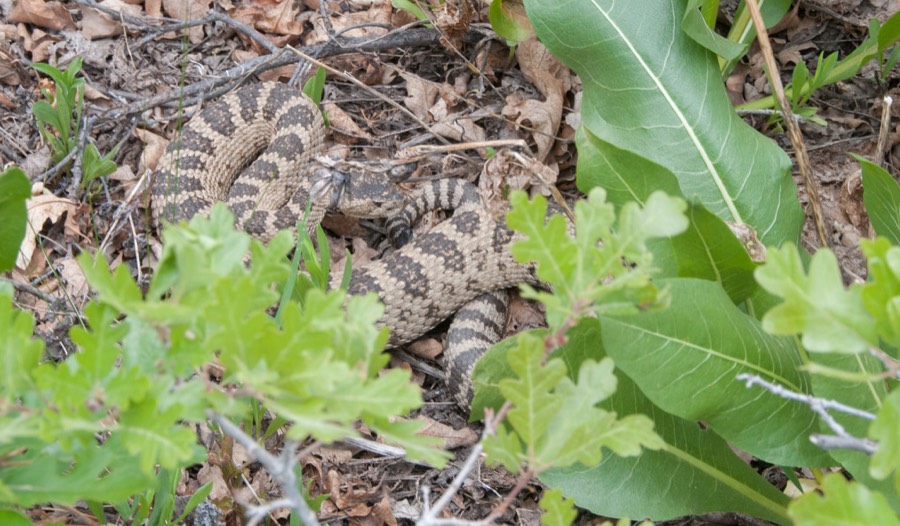
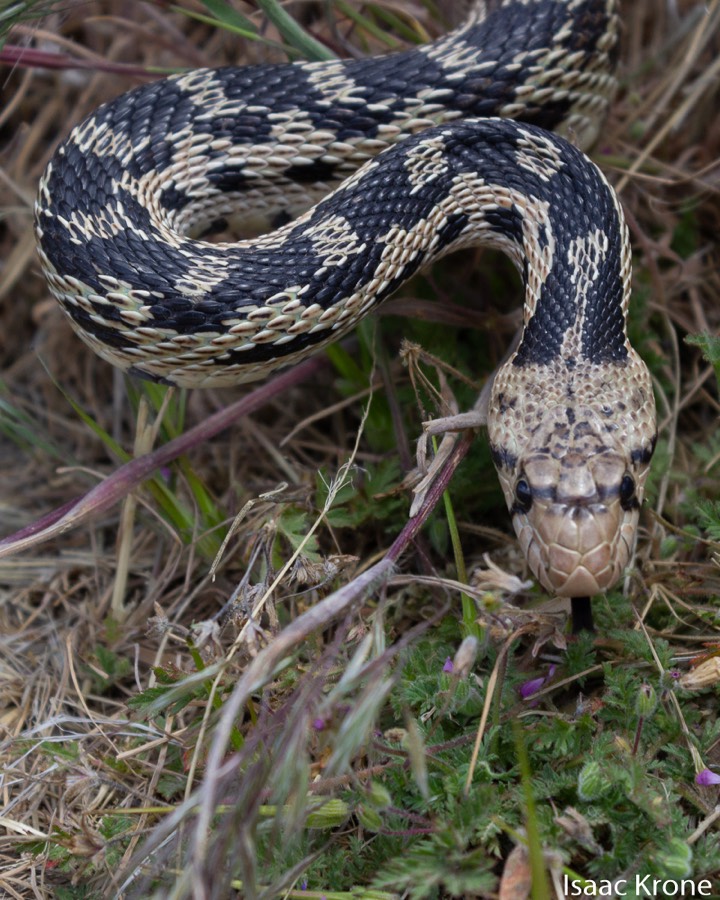
Snakes (incl. Rattlesnakes)Great Basin rattlesnake vs. the harmless gophersnake
Protected — do not killDWR / relocator
What it is
Most snakes anyone sees are harmless. The gophersnake (the most common snake in Utah) mimics a rattler — it hisses and vibrates its tail — but has a slender pointed tail (no rattle), a round pupil, and a narrow head. The Great Basin rattlesnake (the only venomous snake on the Wasatch Front) has a broad triangular head, vertical pupils, and a blunt tail tipped with a rattle. Bench and foothill schools see them most.
The legal reality
Rattlesnakes — and native snakes generally — are protected under Utah law; it is illegal to harass or kill one, a class B misdemeanor, except in genuine defense of a person. Utah DWR; protected since 1989.
DIY or pro?
Nobody grabs a shovel. For a rattlesnake anywhere students use, contact DWR or a licensed snake relocator — they move it to native habitat legally. A harmless gophersnake can simply be left alone or gently encouraged out; it actually keeps rodents down.
Threshold
A rattlesnake in a student-use area means call a relocator or DWR, mark the spot, and keep students back. Don’t kill it — that’s when most bites happen, and it’s illegal.
Look-alike: rattlesnake vs gophersnake
Great Basin rattlesnake with a banded, blunt tail tipped by a rattleGreat Basin rattlesnake · blunt tail + rattle
Gophersnake with a narrow head, round pupil, and slender pointed tailGophersnake · narrow head, pointed tail
The look-alike that matters. The harmless gophersnake mimics a rattler by hissing and vibrating its tail. Head shape, pupil, and tail tip tell them apart. Both are protected, neither is yours to kill.Photos via iNaturalist: Great Basin rattlesnake © Rolf Lawrenz (CC BY); gophersnake © Isaac Krone (CC BY).
RaccoonsProcyon lotor — legal to control, illegal to relocate
Watch itWildlife control
What it is
Gets into dumpsters, crawlspaces, attics, and chimneys; tears insulation; raids trash. A wildlife-control problem more than a pest one.
The legal reality
Raccoons can legally be controlled in Utah at any time — but relocating or holding a live raccoon is prohibited. So “trap and release somewhere else” is not a legal option. Utah Admin. Code R657-3b-9(7); R58-14.
Health note
Rabies vector; also carries leptospirosis and the raccoon roundworm (Baylisascaris). No staff member handles one, and droppings are treated as a hazard.
DIY or pro?
Licensed wildlife-control operator. The lasting fix is exclusion — secure dumpsters and bins, cap chimneys, and seal crawlspace and attic access.
Threshold
Denning in a structure, or aggressive or daytime behavior, means a wildlife-control operator now.
Skunkscross-reference — full entry in §4, Grounds
Watch itWildlife control
Why it’s here
Skunks are a wildlife-control matter and a rabies vector, but on a school campus you meet them on the grounds first — cone-shaped grub holes in turf and dens under portables and stair landings. Full entry in §4, Athletic Fields, Playgrounds & Grounds.
Pest control vs. animal control vs. DWRPest control handles insects and commensal rodents (mice, rats) and the controllable burrowers (gophers, voles, ground squirrels). Wildlife/animal control handles raccoons, skunks, and the bigger mammals — often with legal limits on relocation. DWR governs protected wildlife — bats, native birds, and rattlesnakes — where the answer is exclusion, permits, or a licensed relocator, never a kill.
10 Specialty Spaces

The Rooms Nobody Writes a Pest Plan For

Every school has these, and none of them show up on a service route.

Science Labs & Specimen Collectionsdermestid beetles — carpet beetles
Watch itDIYSpecialty space
What it is
Small, oval, mottled beetles, and their larvae — small, hairy, and carrot-shaped. The larvae do the damage.
What they eat
Anything dried and animal-derived. Mounted insect collections, taxidermy, feathers, wool, felt, dried specimens, and animal-based glue in old book bindings. A neglected insect collection in a biology closet is a dermestid buffet.
Where else they show up
In wall voids feeding on dead cluster flies and rodent carcasses, which is why treating a wall void full of flies can create a beetle problem.
DIY or pro?
Freezing is the standard fix for collections — 72 hours at 0°F kills all life stages. Store specimens in sealed cases. Vacuum thoroughly.
Threshold
Any larvae or shed skins in a collection means treating the collection before it’s lost.
Photo to comeDermestid larva and shed skins in a pinned insect collection
The larva does the damage, and the shed skins are what you find first. Small, hairy, carrot-shaped larvae in a drawer of pinned specimens mean the collection goes in the freezer now.
Libraries & Book Rooms
Watch itDIYSpecialty space
What converges here
Silverfish, booklice, and dermestids all converge here, and all three are humidity problems. Below about 50% relative humidity none of them thrive.
The returned-material question
Bed bugs in returned material is a real and documented issue in public libraries. In a school library the volume is lower but the mechanism is identical. Confirm before acting — see §2.
The fix
Environmental: humidity control, air movement, and not shelving books tight against an exterior wall.
Threshold
Any insect damage in a collection means addressing the room before treating anything.
Portable Classroomstheir own pest environment, and rarely inspected
Watch itReport itBuilding envelope
Why they’re different
The skirting creates a dark, protected void at grade — that’s harborage for ground squirrels, skunks, voles, and rodents, and it’s usually never inspected. Utility penetrations through the floor are frequently unsealed. Doors sit on temporary thresholds that gap. Wood-to-soil contact is common.
What to do
Inspect under the skirting seasonally. Seal floor penetrations. Screen the skirting vents. Keep the perimeter clear of stored material.
Threshold
Any burrow, gap, or animal sign under the skirting goes in the log and gets sealed before it becomes a den.
Photo to comeGap in portable classroom skirting, showing the void at grade
The void nobody looks in. A dark, protected space at grade under a classroom full of children, with unsealed utility penetrations overhead, is harborage by design.
Transportation & Bus Yards
Watch itReport it
What happens here
Food left in seats, rodents nesting in engine compartments and under seats over breaks, and wasps building in mirror housings and door frames on parked buses.
The classic case
Buses parked over summer — a bus sitting eight weeks with a food crumb source becomes a rodent problem discovered on the first route in August. Inspect before the first run, not after the first complaint.
What never happens here
Never treat a bus for head lice. See §2.
Threshold
Any nesting material, droppings, or wasp activity found on a pre-service inspection is handled before that bus carries students.
Greenhouses & Ag Programs
Watch itLicensed proSpecialty space
What you’ll see
Aphids, fungus gnats, whiteflies, and spider mites — all humidity and overwatering driven, and all manageable without conventional pesticides in a student space.
The school-specific issue
A greenhouse is an occupied instructional space. Anything applied there is applied where students work. Biological controls and sanitation come first here more than anywhere else in the building, and any application requires notification.
Threshold
Plant damage or population growth means adjust watering and ventilation first, then biological control, and only then a licensed application with notification.
Locker Rooms & Athletics
Watch itDIYReport it
What converges here
Moisture, organic material, and hidden harborage in one room. Drain flies at floor drains, Oriental cockroaches from drains that go dry over breaks, and dermestids in uniform storage and stored equipment.
What to do
Run water in floor drains that sit unused. Launder and dry-store uniforms rather than leaving them bagged. The wrestling mat storage room is the single most overlooked space in most schools.
Threshold
Recurring flies or roaches in a locker room is a drain and moisture finding, and it goes in the log as one.
Cross-reference

What School Staff May and May Not Do

The licensing line, and it’s different for public employees.

The line, and which side you’re on
Always allowed
No license, no permission needed. Monitoring devices and sticky traps. Snap traps and tamper-resistant stations. Sealing, caulking, door sweeps, screening, exclusion. Sanitation and clutter removal. Removing standing water. Vacuuming. Scraping mud dauber tubes. Knocking down webs and nests with a pole. Trimming vegetation back from the building. That’s most of pest management, and all of it is yours.
Not allowed by anyone unlicensed
Applying any pesticide on school property. This includes consumer products bought at retail. An aerosol from a teacher’s home, an ant bait from a hardware store, a can of wasp spray kept in a custodial closet — all pesticides, all prohibited unless applied by a licensed applicator.
If the school applies its own
R392-200-18(e) requires school personnel who apply pesticides to be licensed and to follow Utah Department of Agriculture and Food regulation R68-7, applying every product according to label directions. Government employees applying pesticides on their employer’s property generally fall under a non-commercial applicator license.
Why it matters
Liability follows whoever applies the product. Keeping mechanical and habitat work in-house and routing chemical application to a licensed applicator is both the legal line and the one that protects the district.
Confirm the category before anyone applies anythingConfirm the correct license category with UDAF at (801) 982-2300 before anyone applies anything. Getting this wrong is a licensing violation attached to the district, not to the individual.
Cross-reference

Notification

The requirement with no commercial equivalent.

R392-200-18(c) requires the school’s IPM plan to include a policy for notifying students, parents, and staff. No commercial or residential pest control carries this obligation, and it is the requirement most often missed.

What notification actually requires
Before an application
Notice stating the product name, EPA registration number, target pest, location to be treated, date and approximate time, re-entry interval, and a contact for questions. Posted at the treated area and at the main entrance, and left up until the re-entry interval has elapsed.
Maintain a registry
Any parent, guardian, or staff member may ask to be notified in advance of every application at their building. Keep the list and use it.
Sensitive individuals
Maintain a confidential list of students and staff with asthma, chemical sensitivity, or known sting allergy. They get direct notification, and their needs factor into product selection and timing.
Exempt from notification — but still recorded
Baits in pre-manufactured tamper-resistant containers where children have no access. Gel or paste baits in cracks and crevices inaccessible to children. Germicides, disinfectants, sanitizers, and products used in routine cleaning.
Emergency applications
Where a pest presents an immediate threat — a stinging insect nest at a doorway, a rodent in a serving line — the IPM Coordinator may authorize immediate treatment. Notification goes out as soon as practicable afterward, and the emergency basis is recorded.
Cross-reference

Protected Species — Don’t Touch

The short list of things it is illegal to kill in Utah.

Bats
All 18 Utah species. Exclusion only, and not during maternity season (mid-May–mid-August — summer break). A colony needs a DWR-permitted operator.
Native birds
Nearly every bird except pigeon, starling, and house sparrow — including swallows, robins, finches, and native sparrows. Active nests with eggs or young are off-limits.
Raptors
Hawks, owls, eagles — strictly protected. Never a removal; a permitted or DWR matter. Also: rodenticide can poison the raptors that eat poisoned rodents.
Rattlesnakes
And native snakes generally. Illegal to harass or kill except in defense of a person. Use a relocator or DWR.
When in doubtIf you’re not certain it’s one of the three unprotected pest birds or a controllable rodent or insect, treat it as protected and get guidance first. An exclusion plan is almost always legal; a kill often isn’t.
Cross-reference

Mosquitoes & Standing Water

Source reduction is the whole game, and it needs no license.

Mosquitoes & Standing Water
Why it matters
Mosquitoes are the one summer nuisance with a real health angle in Utah — they can carry West Nile virus.
Where schools hold water
Tire swings and playground equipment that collects rain. Sandbox covers. Retention basins and bioswales. Roof drains and downspout discharge. Irrigation low spots on fields. Buckets and equipment left over summer break. Courtyard planters.
The core fix
Source reduction is the whole game and needs no license. Empty or drain anything holding water for more than a few days, keep gutters and catch-basins flowing, and fix chronic low spots that pond after irrigation.
For water you can’t drain
Bti dunks or granules — a biological larvicide, sold over the counter, targeting mosquito larvae, safe around people, pets, fish, and wildlife.
Free public resource
Your local mosquito abatement district will assess and treat breeding sources for free — call them before you spend a dollar.
Threshold
Standing water plus biting pressure around occupied areas means source-reduce first, dunk what you can’t drain, and loop in abatement for persistent breeding.
Take-home

The Custodian’s Toolkit

Everything in this guide you can legally do, and the cheap tool that does it.

Flashlight
The most-used tool in pest management and the one nobody counts. Most of what you need to find is in a place you can’t see without one.
Cobweb / pole sweeper
About $40. The entire method for paper wasp and mud dauber nests. No chemical needed.
Snap traps
The reliable rodent and vole tool. Perpendicular to the wall, trigger end touching it — rodents run along walls — with a dab of peanut butter, not a pile.
Tamper-resistant stations
Anyone can buy them; they’re just a lockable box. Put a baited snap trap inside for a set that’s safe around students and legal without a license.
Sticky monitors
Placed and dated, they tell you what’s active and where, before you see anything. This is how you find a problem while it’s still small.
HEPA shop vac
The right answer for boxelder bugs, elm seed bugs, cluster flies, crickets, and harmless spiders. Never for deer mouse droppings — wet-clean those.
Copper mesh, steel wool, ¼″ hardware cloth
Exclusion material. Sealing entry points is the only permanent rodent fix.
Caulk and door sweeps
The single highest-return item on this list. A failed door sweep is an open invitation for rodents, crickets, and everything else that walks.
Stiff drain brush + enzyme product
Solves drain flies permanently. Bleach doesn’t.
Sealed hard-sided containers
For dry storage. Paper sacks are not storage — they’re packaging.
Bti dunks or granules
Over-the-counter biological larvicide for standing water you can’t drain. Safe around people, pets, fish, and wildlife.
Consumer ant bait
For nuisance ants. Let them carry it home. Don’t spray the trail.
A camera — your phone
Photograph what you find, with something for scale. A photo sent to an entomologist is faster and cheaper than a service call.
A moisture meter
Under $50. Settles the question behind carpenter ants, silverfish, Oriental cockroaches, and half of everything else.
Take-home

DIY That Backfires

Well-meant fixes that create a bigger, costlier problem.

Spraying German cockroaches or bed bugsOver-the-counter sprays scatter them into wall voids and between rooms, and entrench the infestation. These are the two pests where the wrong first move triples the cost of the right one.
Treating a room for head liceZero benefit, real pesticide exposure to children, and it is the most common unnecessary application in American schools. There is no version of this that’s justified.
Treating a bed bug introduction as an infestationConfirm identification and scope first. A few insects on a backpack is not a building problem, and treating it like one alarms a community and wastes money.
Spraying an ant trailSplinters the colony into satellite nests. One trail becomes four. Bait it or wipe it.
Bait stations left unservicedAn empty or neglected station becomes harborage — sheltering the rodents it was meant to control, and a favorite hiding place for black widows in exactly the dark undisturbed cavity they like. A station is an asset only if it’s serviced.
Sealing a bat colony in during maternity seasonMid-May to mid-August traps flightless pups. Illegal, kills the pups, leaves dead animals in the wall, and drives adults into occupied space. The obvious time — summer break — is the wrong time.
Knocking down an active swallow nestA violation, not a cleanup. Exclude in March before they build.
Vacuuming deer mouse droppingsAerosolizes hantavirus in exactly the enclosed spaces where the risk is highest. Wet it down first, always.
Treating a wall void full of cluster fliesThe carcasses feed dermestid beetles, and you’ve traded a nuisance for a fabric and specimen pest. Vacuum and exclude instead.
Letting drains go dry over breakA dry floor drain loses its trap seal, and that’s the open door Oriental cockroaches and sewer odors use. Run water in unused drains monthly.
Storing cardboard in a kitchenCardboard is how German cockroaches arrive and where they harbor. Break it down and remove it the day it comes in.
Take-home

When It Becomes a Program

The honest answer on thresholds.

Facilities directors want a number. No health or housing agency sets a magic count — the standards act on evidence, and the decision is professional judgment in context. Here’s what actually drives it in a school.

Rodents & cockroaches
Rodents
One mouse or rat, or fresh evidence — droppings, gnaw marks, rub marks — justifies acting. There is no “wait until you have X.” Control is easiest when numbers are low. In kitchens, serving lines, and cafeterias the practical standard is zero tolerance: a single sign is the trigger.
Cockroaches
One German cockroach in a food area. Oriental cockroaches from a drain means addressing the moisture rather than counting insects.
Stinging insects, stored product, birds
Stinging insects
Any active nest in an area students use, during the school year. Location decides this, not count.
Stored product pests
Any live insect or webbing in product. A single pheromone trap capture triggers a stock inspection.
Birds
There is no “two inches of droppings” rule — that figure isn’t in any OSHA, CDC, or NIOSH standard; it’s industry lore. Action is warranted when droppings, nesting, or flock activity creates a health-code, slip, structural, or use impact. It’s a judgment call, so document the reasoning.
The cleanup distinction
Deer mouse droppings in an enclosed space, and large dried accumulations of bird or bat droppings, are wet-method, respiratory-protection, professional cleanup — a separate decision from whether to start a control program at all.
The threshold, in one lineFor rodents and roaches, the trigger is the first solid evidence. For everything else, it’s the first real impact on health, safety, structure, or use. There’s no number to wait for, and waiting makes all of it harder.
Plan ahead

The School-Year Pest Calendar

Pest pressure in a school follows occupancy, not seasons.

August Back to school

Food returns after ten weeks. Doors propped during move-in. Deliveries surge. Boxelder and elm seed bugs hit south and west walls right as parents arrive. Wasp and yellowjacket colonies are at maximum size — the highest sting-risk window of the year falls in the first weeks of school. Walk every field, playground, and door before students arrive. Inspect buses before the first route.

Sep–Oct Move-in season

Rodents begin entering as nights cool. This is the exclusion window — seal now and you avoid the entire winter problem. Crickets at every door. Best time to exclude bats, once pups can fly. Yellowjackets turn aggressive around food before frost.

Nov–Feb Indoors

Rodent pressure peaks. Heating drives activity into wall voids and above ceiling grids. Stinging insects gone. Cluster flies appear on warm days. Prime trapping and exclusion season.

Mar–Apr Snowmelt and wake-up

Vole runways appear all at once across fields — a winter’s damage revealed in a week. Bird nesting begins: exclude before swallows build, because once eggs are present you’re legally stuck until fledging. Termite swarms possible. Ground squirrels emerge.

May–Jun Wind-down, and the bat trap

Wasp queens start new nests — easiest to remove while small. Bat maternity season begins mid-May: no exclusion until pups fly. End-of-year cleanout is the best sanitation opportunity of the year — use it, especially classrooms and lockers.

Summer break The invisible months

An empty building is not a pest-free building. Floor drains dry out and lose their traps — that’s exactly how Oriental cockroaches come up. Food left in a classroom in June is a problem in August. Construction and renovation open the building envelope. Buses sit. Reduced staffing means nobody’s watching. Schedule monitoring through the summer. This is when problems establish unobserved and get discovered in August.

That’s the hour — and the desk reference to keep.

Keep this where your people work. When a teacher calls about a bug in a classroom, a kitchen manager finds something in the flour, or a parent calls about a wasp at the playground, you’ll know in ten seconds whether it matters, whether you can handle it, whether it’s protected, and whether it goes in the log.

And when it crosses into licensed or protected territory — or you just want a second set of eyes from a Board Certified Entomologist — that’s what the practice is here for.

Trent Frazer, BCEBoard Certified Entomologist · M.S. Entomology · Falcon Pest Control
Keep this guide. Pass it on.

Scan the code, or share the link: any custodian, kitchen manager, or facilities director in Utah can pull up the full reference on their phone in seconds. Free, no login, nothing to install.

myfalconpest.com/school-field-guide